Best Guitar Power Amps 2026: Tube, Solid-State, Hybrid
This guide compares 8 guitar power amps for studio, pedalboard, and stage use, with tube, solid-state, and hybrid models explained in depth.
Quick AnswerFor most rigs in 2026, the Seymour Duncan PowerStage 200 is the best all-around guitar power amp because it pairs cleanly with modelers like the Helix and Kemper and bolts onto any pedalboard. Pure tube purists should pick the Fryette Two/Fifty/Two, and players who need maximum portability should grab the Quilter SuperBlock.
A guitar power amp is the box that turns the low-level signal from your preamp, modeler, or pedalboard into the speaker-level voltage your cabinet needs. It decides how loud you can get and how much clean headroom you have before the sound breaks up. This guide compares eight popular models for home, studio, and stage rigs.
- A 50-100 watt power amp covers most small to medium venues; pure bedroom players rarely need more than 20 watts.
- Solid-state and class D power amps from Seymour Duncan, Matrix, and Quilter pair best with digital modelers because they color the tone less than tube power sections.
- Tube power amps like the Fryette Two/Fifty/Two cost more and weigh more, but they deliver the dynamic feel and breakup most rock and blues players want.
- Pedalboard-format power amps such as the Quilter SuperBlock and Blackstar Amped 1 hit 100-200 watts in a footswitch enclosure and skip the rack entirely.
- Wattage is not the same as loudness; a 50 watt tube amp is usually as loud as a 100 watt solid-state because of how the power sections clip.
#What a Guitar Power Amp Actually Does
Your guitar’s pickups plus any preamp or modeler in front of them put out a signal that’s far too weak to drive a 4x12 cab. The power amp boosts it to speaker level, typically 4 or 8 ohms at between 20 and 1000 watts.
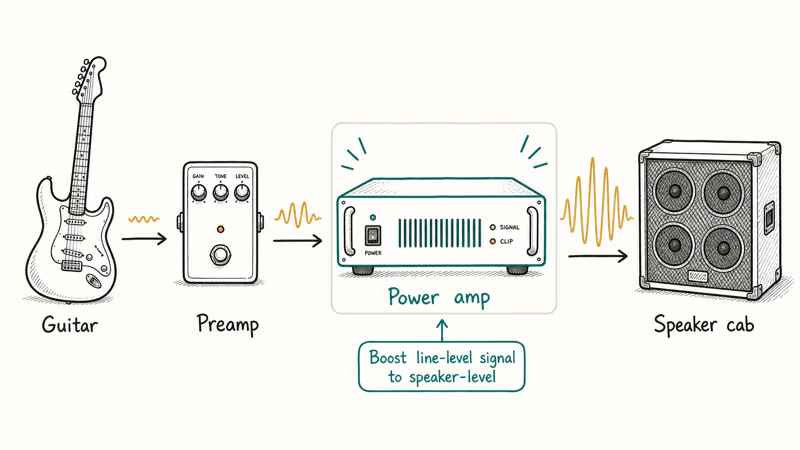
According to Wikipedia’s overview of guitar amplifiers, splitting a rig into a separate preamp and power amp goes back to the rack-mounted touring rigs of the 1970s, when players wanted to swap preamps without losing their power section.
If you run a digital modeler like the Helix, Axe-FX, or Kemper, the modeler already does the preamp and effects work. You only need a power amp and a cab. If you run pedals into a clean preamp, same idea. The power amp is the last stage before your speakers and it has more impact on the final sound than most beginners realize.
For studio work where the amp signal feeds an interface instead of a real cab, an audio interface for Mac plus a good IR loader replaces the power amp entirely. Many players use both: a real power amp for stage volume, an interface for late-night recording.
#How Much Power Do You Actually Need?
Wattage on a spec sheet is not the same as perceived loudness. Tube power amps clip earlier and feel louder than their watt rating suggests, while solid-state amps stay clean further into their output range. Practical wattage guidance breaks down like this:
- 5 to 20 watts (tube) or 50 watts (solid-state): bedroom and home studio. The Marshall Origin 20 in 5 watt mode is plenty for an apartment.
- 30 to 50 watts (tube) or 100 to 200 watts (solid-state): rehearsal rooms, club shows up to 200 capacity. Most working players land here.
- 100 watts (tube) or 500 to 1000 watts (solid-state): loud rock and metal on big stages or stereo wet-dry-wet rigs.
The most common mistake is buying too much power. A 1000 watt Matrix GT1000FX in a bedroom never gets above 5 percent of its output, and the tone-shaping that happens when a power amp pushes harder never kicks in. If you’re tracking the amp signal through software like the picks in our best sound cards for music roundup, even less power is fine because the signal goes direct.
#Tube, Solid-State, or Hybrid: Which Should You Choose?
Three technology families dominate the market, and each fits a different player. Here’s how the tradeoffs break down.
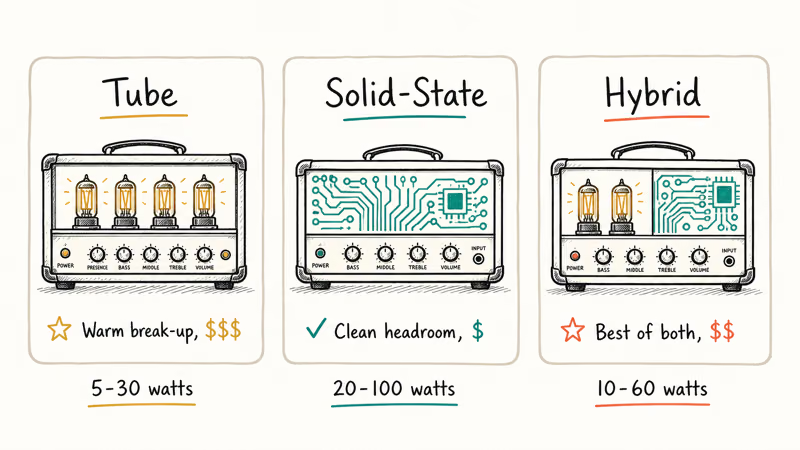
Tube power amps use vacuum tubes (typically EL34, 6L6, or KT88) in the output stage. They sound warm, compress dynamically when you dig in, and most players say the feel under the fingers is more responsive than transistor designs. The tradeoff is weight (a Fryette Two/Fifty/Two is 31 pounds), tube replacement every two to three years of heavy use, and a higher price.
Solid-state and class D power amps use transistors and chip-based output stages. They stay clean to their full wattage, run cool, weigh less than ten pounds in many cases, and cost less per watt. The downside: they don’t compress the same way tubes do, so the response feels stiffer to many players. Solid-state pairs especially well with digital modelers because the modeler is already simulating the tube power section internally.
Hybrid power amps put one or two tubes in front of a solid-state output stage, hoping to keep some of the tube feel while shedding the weight. Results vary; some hybrids feel close to a real tube amp and others feel like a solid-state with a glow lamp. The Thermion Zero is one of the more convincing hybrid options for modeler players, but it’s still not the same as a pure tube power section.
#Matching the Power Amp to Your Speaker Cab
Once you’ve picked tube or solid-state, the next decision is impedance and mono versus stereo. Most guitar cabs are wired for 4, 8, or 16 ohms, and the power amp needs to match. Plugging a 4 ohm cab into an 8 ohm tube output will work for a song but it stresses the output transformer and will eventually cost you a service bill.
Stereo power amps such as the Fryette Two/Fifty/Two run two separate channels into two separate cabs. That gives you wet-dry-wet rigs and true ping-pong delays, but it doubles your transport load. If you only own one cab, save your money and buy a mono unit.
Players who track at home should also consider a load box like the Two Notes Torpedo or the Suhr Reactive Load. A load box sits between the power amp and a fake speaker load, lets the amp run at full bore, and sends a clean DI signal straight to your interface or DAW.
#Top 8 Guitar Power Amps for 2026
The list below compares tone, headroom, weight, build quality, and value. Prices reflect US street as of May 2026.
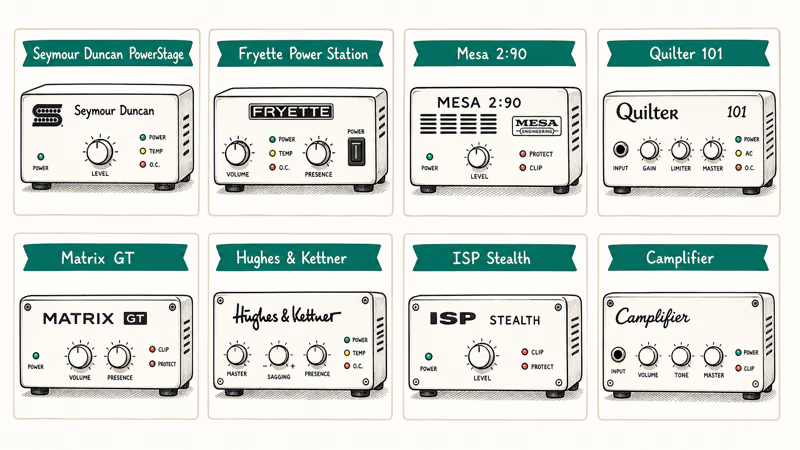
#1. Seymour Duncan PowerStage 200 (best overall)
Seymour Duncan’s PowerStage 200 is a 200 watt class D power amp that fits on a pedalboard and includes a 3-band EQ. It’s a natural fit for compact modeler rigs. According to Seymour Duncan’s official PowerStage 200 product page, the amp delivers 200 watts into 4 ohms and runs on standard mains power without a separate brick.
- Power: 200W @ 4Ω
- Weight: 2.8 lb
- Best for: Pedalboards with modelers like Helix or Kemper
- Tradeoff: No stereo, no power scaling
The PowerStage 200 is built for clean pedalboard volume, and the onboard EQ gives players room to dial in different cabs without reaching for the modeler menu. It’s the easiest recommendation in the entire category if you already own a modeler.
#2. Fryette Two/Fifty/Two (best pure tube)
The Fryette Two/Fifty/Two is a 50-watt-per-channel stereo tube power amp using 6L6 output tubes. It has selectable 4, 8, and 16 ohm outputs per channel, which makes cab matching simple no matter what speakers you own.
- Power: 2 x 50W @ 4/8/16Ω
- Weight: 31 lb
- Best for: Players who want classic tube power amp tone
- Tradeoff: Heavy, expensive (around $1,499), needs tube biasing service
In stereo modeler rigs, the Two/Fifty/Two adds the harmonic richness players often miss with class D amps. The catch is the weight; a wheeled rack is the practical choice.
#3. Matrix GT1000FX (best high-headroom solid-state)
The Matrix GT1000FX puts 500 watts per side into 4 ohms in a 1U rack format that weighs just 9 pounds. According to Matrix Amplification’s official GT1000FX page, the amp has been the standard rack power amp for touring modeler players since around 2010.
- Power: 2 x 500W @ 4Ω
- Weight: 9 lb
- Best for: Stereo wet-dry-wet, big stages with FRFR or guitar cabs
- Tradeoff: Overkill for clubs, premium price
Its appeal is massive clean headroom, cool operation, and a transparent modeler signal path. If you need huge stereo power without lugging a tube monster, this is the pick.
#4. Quilter SuperBlock (best pedal-format)
The Quilter SuperBlock series puts 200 watts of solid-state power into a small pedalboard footprint with built-in voicings. There are US and UK versions, each modeled on a different vintage power amp character.
- Power: 200W @ 4Ω
- Weight: 1.9 lb
- Best for: Pedalboard rigs that want a touch of analog flavor
- Tradeoff: Single channel, no stereo
The SuperBlock UK targets players who want a solid-state amp with more vintage-amp character than a transparent class D pedal. If you want a solid-state amp that still has some character of its own, this is the one.
#5. Marshall Origin 20 (best tube combo under $700)
The Marshall Origin 20 is a 20-watt tube combo with EL34 output tubes and a power scaling switch that drops it to 5 watts or 0.5 watts. Marshall states that the 20 watt mode is built for small-club gigs and the 0.5 watt mode is built for late-night practice. The lower mode is the practical home setting.
- Power: 20W / 5W / 0.5W (tube)
- Weight: 39 lb (combo)
- Best for: Single-channel classic rock players who want a real tube sound at home
- Tradeoff: Only one channel, no FX loop on some versions
It’s a combo, not a standalone power amp, but plenty of pedalboard players run their pedals into the Origin 20’s clean channel and treat the power section as the amplifier. It works.
#6. Blackstar Amped 1 (best pedal-format with cab sim)
The Blackstar Amped 1 is a 100 watt class D pedal-format amp with three voicings, a CabRig speaker simulator for direct recording, and a fully featured effects loop. It found a niche with players who switch between a real cab on stage and a direct signal at home.
- Power: 100W @ 4Ω
- Weight: 2.6 lb
- Best for: Hybrid rigs that need both cab and direct output
- Tradeoff: Voicings are fixed; less tone flexibility than the PowerStage
The CabRig direct output is useful for demos that don’t justify mic’ing a cab.
#7. Thermion Zero Dynamic Hybrid
The Thermion Zero is a hybrid amp that runs a 12AX7 preamp tube into a class D power section, plus built-in reverb and stereo I/O. According to Thermion’s spec page, the Zero puts out about 60 watts per side and was designed for fly gigs.
- Power: 60W per side (hybrid)
- Weight: 4.4 lb
- Best for: Touring players who want tube preamp warmth in a flight-friendly box
- Tradeoff: Limited availability outside Europe, hybrid feel isn’t full tube
The reverb is the surprise feature; it can replace a separate pedal in compact rigs.
#8. Fryette Two/Ninety/Two (best touring tube rig)
The Two/Ninety/Two is the big brother of the Two/Fifty/Two: 90 watts per channel of stereo 6L6 power. It’s what you bring when the venue is loud, the band is loud, and you don’t want to run out of clean headroom in the second set.
- Power: 2 x 90W tube
- Weight: 47 lb
- Best for: Touring rigs that need both clean headroom and tube feel
- Tradeoff: Heavy, expensive (well over $2,000), real road case required
If your budget supports it and your back tolerates it, this is the tube power amp many session players still rate as the best stereo unit ever built.
#Best Picks by Use Case
The same eight amps can also be grouped by how you play.
- Pedalboard rig with a modeler: Seymour Duncan PowerStage 200, Quilter SuperBlock, or Blackstar Amped 1.
- Stereo wet-dry-wet at high volume: Matrix GT1000FX or Fryette Two/Ninety/Two.
- Tube tone first, weight second: Fryette Two/Fifty/Two or Marshall Origin 20.
- Travel and fly gigs: Thermion Zero or Quilter SuperBlock.
- Mostly recording, occasional live: any of the class D picks, plus a quality interface and IR loader.
If you spend most of your time tracking, route the power amp into a load box rather than a speaker; the best audio compressors we cover in our studio guide pair well with the dry DI signal a load box produces.
For phone-based jamming and lessons, you can skip the power amp entirely and go straight from a small interface into your iPhone. Our walkthrough on how to connect a microphone to iPhone covers the cable order, and a music theory app like Tenuto or Functional Ear Trainer turns silent practice time into something useful between gigs.
#Bottom Line
If you’re buying one amp and you already own a digital modeler, get the Seymour Duncan PowerStage 200. It’s small, light, clean, and doesn’t fight the modeler. If you want a real tube power section and you can carry it, the Fryette Two/Fifty/Two is still the unit to beat in stereo. For the absolute smallest rig that can still fill a club, the Quilter SuperBlock UK is the pick we’d take on a fly date tomorrow.
Avoid the temptation to over-buy power. Most working players are better served by 50 to 100 tube watts or 200 solid-state watts than by 1000 watts they never use.
#Frequently Asked Questions
Do I need a separate preamp with a power amp?
Only if your signal source is a guitar and pedals. Modelers, profilers, and amp-modeling pedals already include a preamp stage, so you go straight from the modeler’s output into the power amp’s input. A guitar plugged directly into a power amp has no gain staging and sounds thin.
Can I run a power amp into headphones?
No. Power amps deliver speaker-level voltage that will damage headphones and possibly your hearing. Use the headphone output on your modeler or interface instead, or pair the amp with a load box that has its own headphone jack.
How loud is 50 watts on stage?
A 50 watt tube power amp through a 2x12 cab will keep up with an unmiked rock drummer in a small club, roughly 250 capacity. A 50 watt solid-state amp in the same rig can feel quieter because it doesn’t compress the same way at full output. For bigger rooms with monitors and PA support, 50 tube watts is still plenty.
Are class D power amps as good as tube power amps?
For modeler players, yes; for guitarists who want the power section to add character, not always. Class D stays cleaner and lighter, while tube designs add harmonic content and respond to picking dynamics. Pick based on whether you want the power amp to disappear (class D) or to be part of your sound (tube).
Can I use a PA power amp for guitar?
You can, but PA amps are voiced flat across the full audible range and don’t shape the midrange the way guitar power amps do. The result is usually a sterile, harsh tone, especially with high-gain sources. If you only have a PA amp on hand, run an IR loader in front of it to shape the response.
Will a guitar power amp work with a bass cabinet?
Electrically yes, tonally no. Guitar power amps don’t have the low-end roll-off bass cabs expect, and the high frequencies a guitar amp produces can damage some bass speakers over time. If you only own one cab, get one labeled full-range or guitar-specific.
How often do tube power amps need new tubes?
For weekly gigging players, plan on retubing every 18 to 24 months. Bedroom players who run the amp a few hours a week can stretch that to four or five years. The first sign of tired tubes is a loss of low-end punch and a slow, fuzzy attack on chords.
What’s the difference between watts and headroom?
Watts measure raw output; headroom measures how much of that output stays clean before the power section starts clipping. A 100 watt amp with low headroom can sound smaller than a 50 watt amp with high headroom, because the bigger amp distorts earlier. When the spec sheet says clean headroom, that’s the number to compare.

Best Laptop for Running LLMs in 2026: Memory Comes First
The best laptop for running LLMs is a memory purchase first. Compare MacBook unified memory against NVIDIA laptop VRAM, and see what each tier really runs.

Pixel 11 vs Pixel 10: What Changed and Who Should Upgrade
Pixel 11 vs Pixel 10: same screen and camera resolution, new Tensor G6, 25W wireless, and Gemini Intelligence. Here is who should actually upgrade.

Best Power Bank for iPad in 2026: Pro, Air, and Mini
Best power bank for iPad in 2026. Compare mAh tiers and USB-C PD wattage for iPad Pro, Air, and mini, plus airline Wh math, cables, and travel tips.
Best Power Bank With Built-In Cable: Top 2026 Picks
Best power bank with built-in cable picks for 2026. Compare single USB-C, multi-connector, and retractable laptop banks, plus airline Wh math.