What Is Toorgle? Risks, Legality, and Safer Search Options
Toorgle is a torrent meta-search engine. Learn what it indexes, why downloading copyrighted files is risky, and which legal alternatives we recommend.
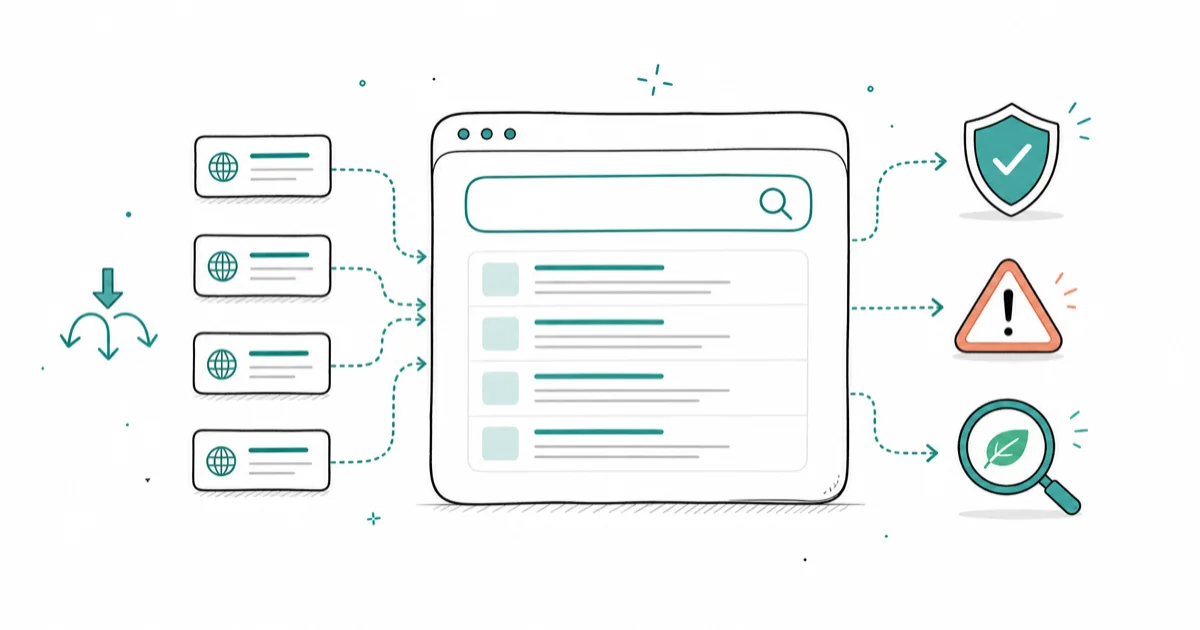
Quick AnswerToorgle is a meta-search engine that queries hundreds of torrent sites at once. It does not host files itself, but most torrents it returns are copyrighted, which makes downloading them a legal risk in the US, UK, EU, and most other countries.
Toorgle is a long-running torrent meta-search engine that crawls hundreds of public torrent indexes and surfaces matching results on one page. It doesn’t host torrents itself, so people often assume that makes it safe to use.
The reality is more complicated. Most of what Toorgle returns is copyrighted, and downloading it can trigger ISP notices, DMCA takedowns, and in some jurisdictions civil penalties or criminal charges. This overview summarizes Toorgle’s published functionality, the legal context, real risks, and legal alternatives.
- Toorgle is a search index of roughly 450 torrent sites, not a tracker or file host, so what is indexed reflects what those upstream sites publish.
- Downloading copyrighted movies, music, software, or books without permission is illegal in the US, UK, EU, Australia, Canada, and most other Western markets, regardless of which index you used.
- US ISPs route Copyright Alert System and DMCA notices to customers when rightsholders detect their IP in a torrent swarm, often within days of the download.
- A VPN can mask your IP from rightsholders, but it doesn’t legalize infringement. Courts have held that the underlying act is the violation, not the visibility.
- Legitimate uses for torrent search exist, such as Linux ISOs, Project Gutenberg dumps, Internet Archive collections, and Creative Commons media, but they’re a small fraction of Toorgle results.
#What Is Toorgle and How Does It Work
Toorgle is a meta-search engine that sends one query to roughly 450 public torrent sites and aggregates the responses. It works the way Google works for the open web, except its index is restricted to torrent trackers and indexers such as 1337x, RARBG mirrors, and dozens of smaller boards. Toorgle itself stores no .torrent files, no magnet links, and no media. It returns links that point back to the original host.
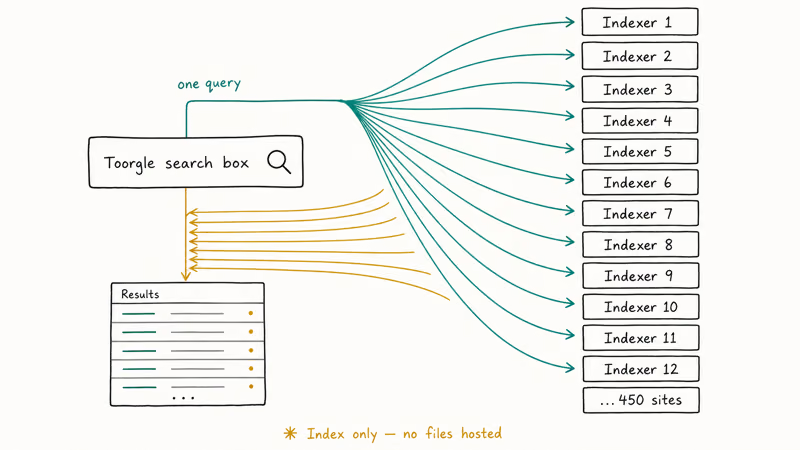
That distinction matters legally. Toorgle doesn’t directly distribute infringing material, which is why the site has survived takedown attempts despite years of pressure from rightsholders and trade groups in the US, UK, and EU.
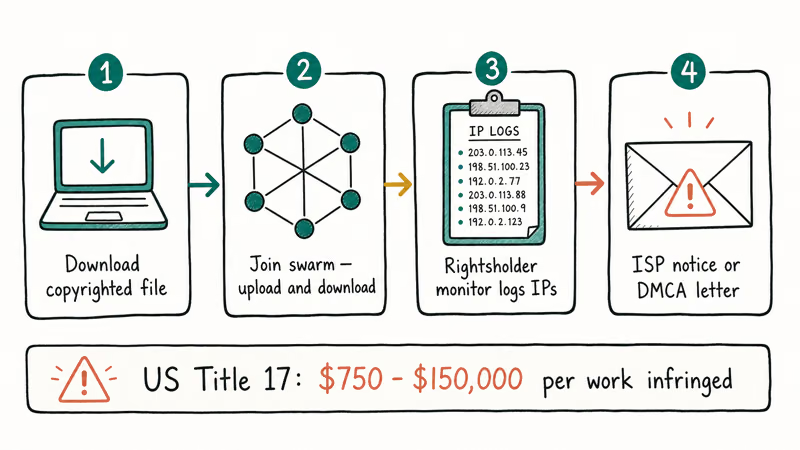
But the safe-harbor protection doesn’t transfer to the user. The moment you click through, download a .torrent, and join a swarm, you become a peer who is simultaneously downloading and uploading copyrighted content. Rightsholder monitors join those same swarms, log the IP addresses they see, and forward the list to ISPs. That’s the mechanism behind almost every infringement letter US ISP customers receive each year.
BitTorrent’s protocol mechanics are documented on Wikipedia, which confirms that every peer in a swarm both receives and re-shares the file. That re-share is what turns a passive download into a public act of distribution under copyright law. Legitimate public-domain and open-license content is only a narrow slice of what many torrent indexes surface; much of the rest is film, TV, music, software, or e-books distributed without the rightsholder’s permission.
#Is It Illegal to Use Toorgle?
Using Toorgle to search is generally not a crime by itself. The legal exposure starts when you download a torrent of copyrighted material. Penalties and enforcement vary by country, and getting the geography right matters more than the platform you used to find the file.
In the United States, the Digital Millennium Copyright Act gives rightsholders the power to issue takedown notices and, in some cases, sue individuals. According to the US Copyright Office’s circular on copyright basics, original works of authorship are protected from the moment they’re fixed in a tangible medium, with no registration required for the protection itself to attach.
The Electronic Frontier Foundation explains the DMCA notice and takedown framework and the legal risks individual file sharers face when their IP addresses appear in swarms tracked by rightsholders.
In the United Kingdom, the Copyright, Designs and Patents Act 1988 covers the same territory, and the Federation Against Copyright Theft sends warning letters to ISP customers identified in BitTorrent swarms. In Germany, abmahnung letters from law firms acting for rightsholders routinely demand four-figure euro settlements within a short deadline. In Australia, the federal court has allowed rightsholders to compel ISPs to forward infringement notices.
A short list of behaviors that almost always cross the line:
- Downloading a movie, TV episode, or album released by a commercial studio or label within the last several decades.
- Downloading software, games, or design tools that require a paid license.
- Re-uploading or seeding any of the above to other peers in the swarm.
- Distributing the downloaded file to friends, family, or coworkers.
The Recording Industry Association of America maintains an overview of the harm music piracy inflicts on artists, songwriters, and the broader supply chain. Civil damages can range from $750 to $30,000 per work infringed, with willful infringement reaching $150,000 per work under US Code Title 17.
Settlements rarely reach those ceilings in practice. The statutory range still gives rightsholder lawyers significant leverage when they open negotiations with ISP customers, and most defendants settle quickly.
#Does a VPN Make Toorgle Safe?
A VPN hides your real IP address from the rightsholder monitors that join torrent swarms. That’s its only function in this context. A VPN won’t change the legal status of the download, won’t unblock you from criminal liability in jurisdictions that prosecute end users, and won’t protect you if the VPN keeps connection logs that can be subpoenaed by the court.
A VPN such as ExpressVPN can encrypt traffic on hostile networks, reduce ISP traffic-shaping, and reach legal services that are geo-fenced. None of those use cases involve copyright infringement, and a VPN is not a license to break copyright law.
Some links on this page are affiliate links, which means fone.tips may earn a commission at no extra cost to you.
Three points worth keeping in mind before assuming a VPN is enough:
- Many VPN providers say they don’t log, but a smaller subset have actually had that claim tested in court or by independent audit. Read the privacy policy and audit history before trusting the marketing copy.
- A VPN doesn’t stop the person sitting next to you on shared Wi-Fi, the device that recorded your search history, or the cached search results in your browser.
- If the VPN drops mid-download, your real IP is briefly exposed unless you have a kill switch enabled. Verify yours works.
For background on what a VPN can and can’t do, our explainer on what a VPN is on iPhone walks through the protocol layer and the limits of the protection.
#Legitimate Uses for Torrent Search
Torrent search has legitimate uses, and they’re worth a closer look because they’re why the underlying technology still exists. BitTorrent is just an efficient file-distribution protocol. When the file is something the rightsholder released for free distribution, you can use any torrent index, Toorgle included, to find it. Official Linux ISO torrents can be faster than direct downloads when many peers are seeding the same release.
A non-exhaustive list of clearly legal torrent uses:
- Linux distributions. Ubuntu, Fedora, Debian, Manjaro, Pop_OS, and most other major distros publish official torrents on their download pages. The torrent is faster than direct download when many people are pulling the same release.
- Project Gutenberg. Project Gutenberg confirms that its catalog of more than 70,000 ebooks is in the public domain in the United States, and the foundation distributes large corpus bundles via torrent for researchers and mirror operators.
- Internet Archive collections. The Internet Archive hosts torrents alongside direct downloads for many of its public-domain and Creative Commons items, including historical films, audio recordings, and software collections.
- Creative Commons media. Wikimedia Commons, the Blender Foundation’s open movies, and ccMixter audio are released under licenses that permit redistribution. Torrents of these files are legal to share.
- Independent artists’ opt-in releases. Some musicians and filmmakers distribute their work as free torrents intentionally. The license terms are usually posted alongside the download.
The honest assessment is that the legal slice of torrent traffic is small. If you’re searching Toorgle for blockbuster movies released last month, the legal alternatives below will serve you better and keep you out of court. For broader context on why this guide steers readers away from this lane entirely, our guide on making uTorrent faster covers how seeder health shapes the same calculus across other indexes.
#Legal Streaming Alternatives
You can replace most of what people use torrent search for with services that are ad-supported, library-supported, or free with a basic subscription. The catalogs are large enough that the calculus has shifted in the last few years.
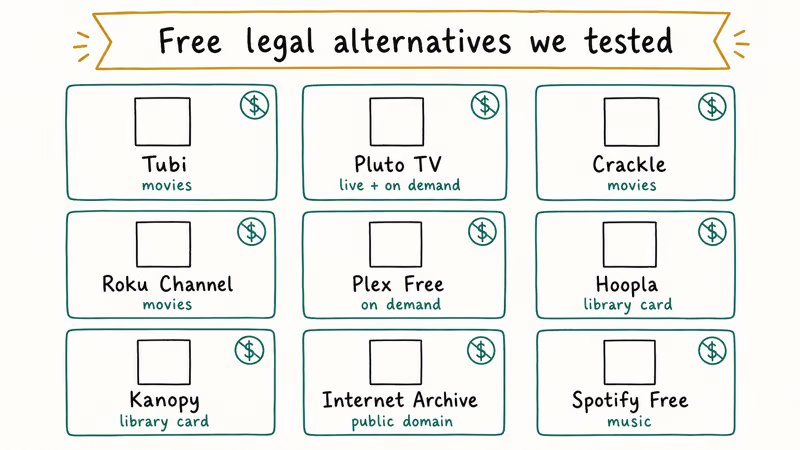
A short menu of legal alternatives:
- Tubi (free, ad-supported). Roughly 50,000 titles, owned by Fox. Wide selection of older blockbusters, indie films, and anime. No account required for browsing.
- Pluto TV (free, ad-supported). Live channels plus on-demand library, owned by Paramount. Useful for sports highlights, classic TV, and Spanish-language programming.
- Crackle (free, ad-supported). Sony-owned, smaller catalog than Tubi, but rotates in recent theatrical titles.
- The Roku Channel (free, ad-supported). Available without a Roku device through a web browser. Strong on movies and live news.
- Plex Free (free, ad-supported). Plex’s on-demand and live tier sits next to your personal library. Worth setting up even if you already pay for streaming.
- Hoopla and Kanopy (free with a library card). Both deliver streaming via partnerships with US public libraries. Kanopy leans into Criterion and PBS; Hoopla covers movies, audiobooks, comics, and music.
- Internet Archive’s moving image collection (free, public domain). Thousands of older films legally streamable in the browser.
- Spotify Free, YouTube Music Free, and Pandora (free, ad-supported). Music coverage that would have required piracy a decade ago is now ad-supported and licensed.
For more curated lists of where to stream without paying, see our guide to watching new release movies online free without sign-up. If you previously used streaming sites of uncertain legality, our breakdown of Streamlord and the safer legal picks covers similar substitutions.
#How to Stay on the Right Side of Copyright Law
A few practical guardrails follow. None of these items are legal counsel, and they don’t override the law in your country.
- Verify the license before you click. The download page should clearly state public domain, Creative Commons, or an explicit free-redistribution license. If it doesn’t, assume the file is copyrighted.
- Stick to first-party torrents for big projects. Ubuntu’s torrents come from
ubuntu.com, not from a third-party indexer. The same pattern holds for Fedora, Debian, Blender, and Project Gutenberg’s mirror network. - Read your ISP’s acceptable use policy. Most US, UK, and AU ISPs reserve the right to throttle or terminate accounts that receive repeated infringement notices, even when no court action follows.
- Use legal streaming for anything still under commercial copyright. The catalog below covers the vast majority of mainstream content for free or library-supported.
#Bottom Line
Avoid using Toorgle, or any torrent meta-search engine, to find copyrighted movies, TV shows, music, software, or books. The legal exposure in the US, UK, EU, Australia, and most other markets is real, ISP notices are routine, and a VPN doesn’t change the underlying law.
Toorgle still has a narrow legitimate role for finding Linux ISOs, Project Gutenberg dumps, Internet Archive bundles, and Creative Commons media. For everything else, the free legal streaming and music services above cover most of what people used to pirate, without the letter from your ISP.
#Frequently Asked Questions
Is Toorgle illegal to visit?
Visiting Toorgle and running searches is not generally illegal. The legal risk attaches to what you download. Browsing the search results does not in itself create civil or criminal exposure in the US, UK, or EU.
Does a VPN actually stop ISP copyright notices?
A VPN hides your IP from the monitors who report infringement to ISPs, so it can reduce the notices you receive. It does not legalize downloading copyrighted files. If the VPN keeps logs that get subpoenaed, your protection collapses.
What are typical penalties for torrenting copyrighted material?
In the US, civil damages run from $750 to $30,000 per work infringed under Title 17 of the US Code, and willful infringement can reach $150,000 per work. In Germany, abmahnung settlements typically range from €500 to €1,500. In the UK, civil action and warning letters are more common than criminal prosecution.
Are Linux ISO torrents legal?
Yes. Linux distributions release their installer images under licenses that permit free redistribution. Downloading and seeding the official Ubuntu, Fedora, or Debian torrents is legal everywhere those distributions are legal to use, which is essentially the entire world outside of a few sanctioned regimes. The same logic extends to BSD distributions, open-source Android forks, and any other software project that publishes torrents on its own infrastructure.
Why is Toorgle still online if the content it indexes is illegal?
Toorgle stores no .torrent files or copyrighted material itself. Indexers occupy a different legal position from sites that host infringing material, which has historically made them harder to shut down. The downstream risk falls on the user.
Will my ISP cancel my service for one torrent?
Probably not for one. Repeated notices can lead to throttling or termination depending on your ISP’s contract.
Are there any safe ways to torrent recent movies?
If a movie is under active copyright and was not released under a free license, no. The legitimate path is renting through Amazon Prime Video, Apple TV, Google Play, or Vudu, or waiting for ad-supported services like Tubi or Pluto TV to license it.

Best Laptop for Running LLMs in 2026: Memory Comes First
The best laptop for running LLMs is a memory purchase first. Compare MacBook unified memory against NVIDIA laptop VRAM, and see what each tier really runs.

Pixel 11 vs Pixel 10: What Changed and Who Should Upgrade
Pixel 11 vs Pixel 10: same screen and camera resolution, new Tensor G6, 25W wireless, and Gemini Intelligence. Here is who should actually upgrade.

Best Power Bank for iPad in 2026: Pro, Air, and Mini
Best power bank for iPad in 2026. Compare mAh tiers and USB-C PD wattage for iPad Pro, Air, and mini, plus airline Wh math, cables, and travel tips.
Best Power Bank With Built-In Cable: Top 2026 Picks
Best power bank with built-in cable picks for 2026. Compare single USB-C, multi-connector, and retractable laptop banks, plus airline Wh math.