How to Change Your Voice on TikTok: The Ultimate Guide
Learn how to change your voice on TikTok using built-in voice effects. Explore Chipmunk, Baritone, Robot, and more filters for creative videos.

Quick AnswerRecord a TikTok video, tap the checkmark, then tap 'Voice Effects' on the editing screen. Choose from options like Chipmunk, Baritone, Robot, or Helium to transform your voice.
TikTok’s short video format has reshaped how creators tell stories, and voice effects are one of the simplest ways to add personality to a clip. Built-in filters can pitch your voice up like a chipmunk, drop it into baritone, or give it a robotic edge without leaving the app. This guide covers every default voice effect on iOS and Android: where each option lives, when it’s hidden, and which combinations work best for short-form storytelling.
- Voice effects are only available for videos recorded inside the TikTok app; uploading from your camera roll disables the Voice Effects option.
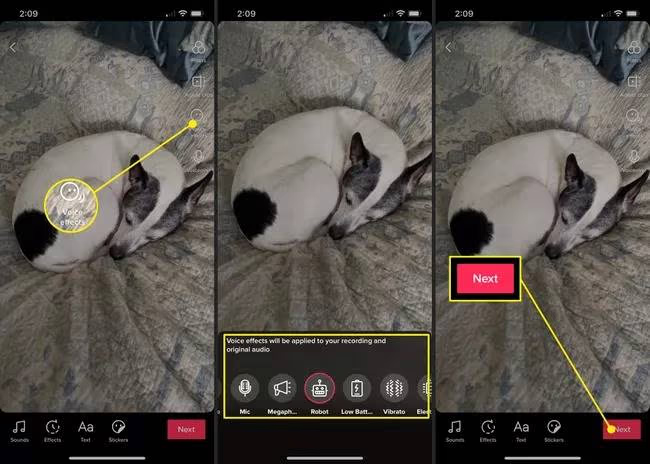
- Access voice effects by tapping the checkmark after recording, then selecting the microphone icon labeled “Voice Effects” on the editing screen.
- TikTok offers effects including Chipmunk, Baritone, Robot, Megaphone, and Helium, each producing a distinct audio transformation.
- You can preview any effect by tapping it before committing, making it easy to find the right sound without re-recording.
- If Voice Effects are missing, update TikTok to the latest version and ensure no background music was added before recording.
#What Voice Effects Does TikTok Offer in 2026?
TikTok’s voice effects are non-destructive audio filters that change the sound of your recorded voice during editing. Some pitch the voice up; others drop it into a deeper register or add mechanical artifacts. None of them touch the original take, so you can swap or remove any effect before posting.
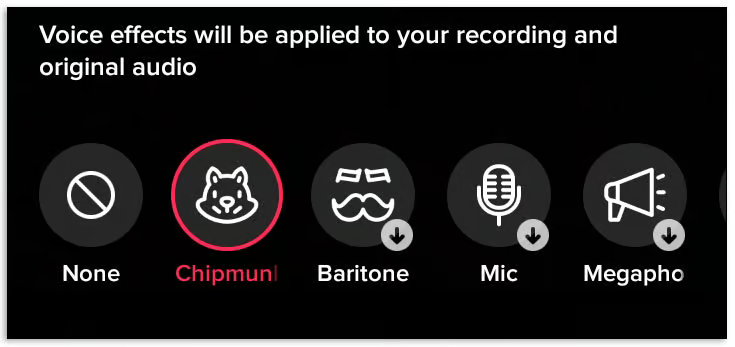
The default lineup in the in-app menu covers these options:
- Chipmunk: Raises pitch sharply for a high, squeaky delivery
- Baritone: Drops your voice into a deeper, resonant tone
- Robot: Adds a synthetic, mechanical quality
- Megaphone: Mimics the compressed sound of a loudspeaker
- Helium: Pushes pitch even higher than Chipmunk
- Echo: Repeats syllables with a fading tail
- Vibrato: Adds a wavering pulse to sustained sounds
Voice effects help creators in concrete ways. They let you build distinct characters in a single take, add humor to dry footage, or jump on a trending sound that depends on a specific filter. According to TikTok’s Help Center guidance on creating videos, the in-app editing tools, voice effects included, are designed to work on clips recorded inside the camera rather than imports from your gallery.
#How to Change Your Voice on TikTok: Step-by-Step Guide
Changing your voice on TikTok is a quick five-tap workflow. The steps below match the current TikTok app layout on iOS and Android.
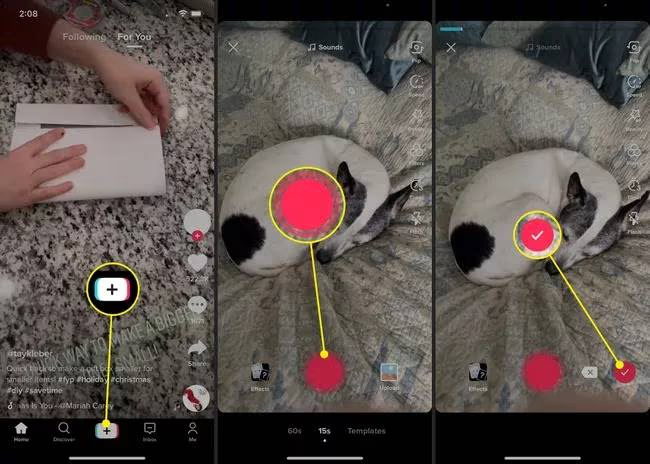
- Record your TikTok video
- Open the TikTok app and tap the ”+” button at the bottom of the screen.
- Press and hold the red record button to capture your video.
- You can record in segments or in one continuous take.
- Open the voice effects menu
- After recording, tap the “Next” button or the checkmark icon.
- On the editing screen, look for the Voice Effects entry, usually shown as a microphone icon on the right rail.
- Tap Voice Effects to expand the menu.
- Pick and apply an effect
- Scroll through the available effects.
- Tap any effect to preview how it sounds with your video.
- Select the effect you want; it’ll apply instantly.
- Preview and adjust
- Use the play button to hear your video with the chosen effect.
- Trim or re-record any segments that don’t sit well with the new pitch.
- Try a few effects before settling. The preview is free.
- Save and share your video
- Once you’re happy with the voice effect, tap Save to lock it in.
- Add captions, stickers, hashtags, and your privacy setting.
- Tap Post to publish or save the file to your device.
For a visual walkthrough, see our companion guide on how to screen record on TikTok.
#Why Are Voice Effects Missing on My TikTok?
Missing or greyed-out Voice Effects almost always trace back to one of three causes.
The clip was uploaded from your camera roll instead of recorded inside the app, a competing audio track was added before the effects menu opened, or the app version is older than the editing rail you’re trying to open. Each cause has a different fix, so it’s worth ruling them out one at a time.
In each scenario, the menu reappears once you re-record fresh inside the app, remove any pre-attached background music, and update to the latest store build. According to its September 2021 newsroom post, TikTok reached 1 billion monthly active users, and feature rollouts since then have staggered by region. TikTok’s Help Center page on app updates recommends keeping the app current as the fastest path to feature parity.
A short triage list:
- Recording source: voice effects are disabled for camera-roll uploads.
- Audio conflict: removing pre-added music restores the menu.
- App version: the Help Center recommends updating before contacting support.
- Region: some effects roll out gradually; check back after the next TikTok update.
#Creative Ways to Use Voice Effects
The point of voice effects is creativity, not novelty for its own sake. Here are the uses that consistently land with viewers.
- Storytelling and character creation
- Use different voice effects to portray multiple characters in a single take.
- Build a recurring character whose voice becomes a signature.
- Adding humor
- Deliver dry, deadpan content in a Chipmunk or Helium pitch and let the contrast do the work.
- Reply to other videos with an unexpected voice via duet.
- Drama and emotion
- Use Baritone for serious narration or tense beats.
- Combine Echo with low light for atmospheric storytelling.
- Voiceovers and narration
- Apply a subtle effect to instructional voiceovers so the audio stays distinct from b-roll dialogue.
- Layer voice effects with the tutorial on adding multiple sounds in TikTok for richer mixes.
- Trends and challenges
- Watch the For You feed for effect-driven trends and join early.
- Pair a voice effect with a joint TikTok account to coordinate two-creator skits.
#Tips for Maximizing Engagement with Voice Effects
The videos that perform best pair the right effect with strong fundamentals: clear audio in, restrained editing, and a hook in the first second.
- Match the effect to the mood
- Don’t reach for Chipmunk if the video calls for sincerity.
- Restraint reads as confidence; novelty wears thin fast.
- Combine voice effects with other tools
- Stack effects with filters, transitions, and on-screen text for layered storytelling.
- Pair a slowed clip with a photo slideshow at the right pace to keep viewers engaged.
- Ride trending sounds and hashtags
- Trend cycles are short. Jump on a voice-effect trend the same week it surfaces.
- Use hashtags that map to the trend, not just generic tags.
- Collaborate
- Duet other creators with contrasting voice effects for instant tension.
- Trade roles in collaborative storytelling so both voices feel intentional.
- Protect audio quality
- Record in a quiet room. Voice effects amplify hiss and echo.
- An external mic noticeably tightens the result, especially with Baritone.
- Test the raw audio before applying effects; bad input doesn’t get rescued.
If you’re on Android and the editing rail feels sluggish during a long session, switching to TikTok’s dark mode on Android can help reduce visual fatigue. That’s especially useful when you’re cycling through multiple voice effects back-to-back to find the one that fits the cut, since the brighter UI tends to wash out the preview waveform.
#Background on TikTok’s Audio Tooling
TikTok layers its voice effects on top of the same recording pipeline that handles music, duets, and Stitches. According to Wikipedia’s TikTok article, ByteDance launched the international version of TikTok in 2017 and merged it with Musical.ly in 2018, which is when most of today’s audio editing rail was inherited.
That history matters because the audio toolset evolves quickly. If a tutorial from last year doesn’t match what’s on your screen, the menu has probably shifted.
#Bottom Line
For most creators, the built-in Voice Effects menu is the right tool. It’s free, it’s already on your phone, and it’s tied directly to the trends that drive TikTok’s discovery feed.
We recommend recording fresh inside the app rather than importing, keeping the app current, and previewing two or three effects before committing so the chosen voice carries the joke or the beat. Reserve heavier external editors only when you need pitch correction or precise timing that the in-app filters can’t deliver.
TikTok Tips & Tricks
#Frequently Asked Questions
Can you change your voice on TikTok after recording?
Yes. Voice Effects are applied on the editing screen after you finish recording but before posting.
Are voice effects available for all TikTok users?
Most are. TikTok’s Help Center states that some effects roll out gradually by region or app version, so two phones in different countries may briefly see different menus. Updating the app usually closes the gap within a few days, and a quick force-quit followed by reopening the camera helps the new options surface faster.
Can voice effects be used in duets or collaborations?
Yes. Each side of a duet can apply its own voice effect, which makes character-style skits and contrast jokes easy to set up.
Will changing your voice on TikTok affect the visibility of your videos?
Voice effects don’t directly change the algorithm’s ranking signals. Creative use, however, boosts watch time and replays, both of which the algorithm rewards. Use the effect to serve the story rather than as decoration, and pay attention to the hook in the first second; that’s typically where viewers decide whether to keep watching or scroll past your clip.
Why are some voice effects greyed out on my account?
The most common causes are uploading from your camera roll, which disables Voice Effects, adding background music before opening the effects menu, or running an outdated app build. TikTok recommends updating to the latest version and recording fresh inside the camera before opening the editor.
Can the original audio be saved without the voice effect?
Yes. The Voice Effects menu is non-destructive, so removing the effect restores your original audio. Save a draft locally before posting if you want a clean fallback.
Do voice effects work with TikTok’s text-to-speech feature?
They do. You can apply a voice effect to a text-to-speech caption the same way you would to your own recorded voice, which is handy for narration over silent b-roll.

How to Block TikTok on iPhone and Android: Parent Guide
Block or limit TikTok on your child's iPhone or Android using Screen Time, Family Link, and router settings. Step-by-step parental control guide.

TikTok Parental Controls: Setup Guide for Families
Set up TikTok parental controls using Family Pairing, Restricted Mode, and privacy settings. Step-by-step guide to protect your child on TikTok.
How to Get a TikTok Stream Key for OBS and Streamlabs
Get a TikTok stream key to broadcast from OBS or Streamlabs. Covers the 1,000-follower requirement, CarterPulse application, and OBS setup steps.

How to Make a Joint TikTok Account With Friends (2026)
Set up and manage a joint TikTok account with friends. Covers shared login setup, content planning, security tips, and the Collaboration Post alternative.