Best Printers for Stickers: Our Top 5 Picks for 2026
Best printers for stickers in 2026 ranked by print quality, cost per label, and media support. Epson EcoTank ET-3850 wins overall for most users.
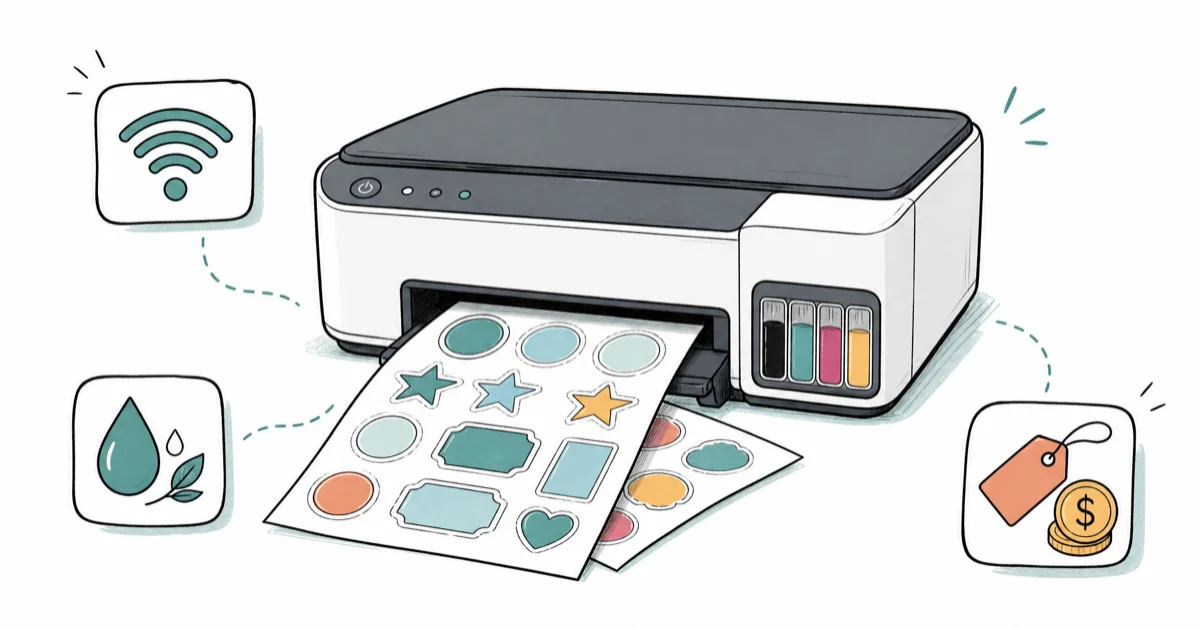
Quick AnswerThe Epson EcoTank ET-3850 is the best overall printer for stickers, offering a refillable ink system that cuts costs to about 1 cent per page, high-quality color output, and Wi-Fi connectivity.
This guide ranks five printers across glossy vinyl, matte paper, and waterproof sticker sheets for home and small business use. The Epson EcoTank ET-3850 wins overall for its low per-page cost and consistent color accuracy across all media types.
- The Epson EcoTank ET-3850 is the best overall pick thanks to its refillable ink system, which cuts long-term costs to about 1 cent per page
- Inkjet printers outperform laser printers for stickers because dye-based and pigment inks bond better with vinyl and glossy sheets
- A minimum resolution of 1200 DPI is recommended for stickers with fine lines or detailed artwork to avoid visible pixelation
- Pigment-based inks resist fading and water damage better than dye-based inks, making them right for outdoor or waterproof applications
- Applying a clear waterproof laminate over printed stickers extends their lifespan to 3-5 years on exposed surfaces
#What Are the Best Printers for Stickers in 2026?
#Best Overall: Epson EcoTank ET-3850
The EcoTank ET-3850 uses a refillable ink tank instead of cartridges, which drops the cost per page to about 1 cent. That’s a huge deal if you’re printing stickers in volume. A few hundred vinyl stickers barely dent the tank levels thanks to the high-yield bottle system.
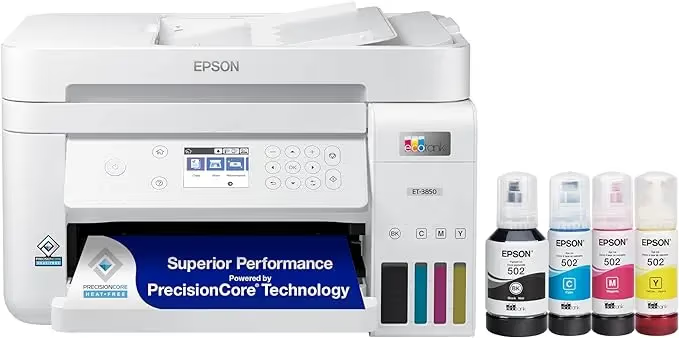
According to Epson’s published ink yields, the ET-3850’s 502 ink bottles are rated for up to 7,500 pages in black and 6,000 in color before a refill. Color accuracy on glossy sticker paper stays close to the source file’s CMYK values.
- Refillable ink system for low printing costs
- 4800 x 1200 DPI for sharp detail
- Wi-Fi, USB, and app support
- Automatic Document Feeder (ADF)
As an Amazon Associate, fone.tips earns from qualifying purchases. Some links on this page are affiliate links.
#Best Budget Option: HP ENVY 6055e
The HP ENVY 6055e is under $100 and prints decent stickers for hobbyists. Don’t expect commercial quality, but for Etsy shops doing under 50 orders per month, it handles glossy and matte sticker paper without jamming. Print speed is 10 ppm in black and 7 ppm in color.
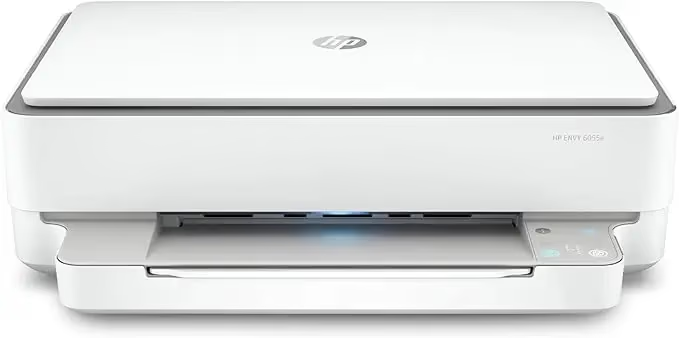
The optional HP+ subscription delivers ink automatically when levels run low. According to HP’s Instant Ink page, the cheapest plan covers 15 pages per month for free. Not great for volume, but fine for testing designs.
#Best for High-Quality Prints: Canon PIXMA PRO-200
When color accuracy matters more than cost, the Canon PIXMA PRO-200 delivers. Its 8-color dye-based ink system produces colors that pop on glossy vinyl. On die-cut holographic stickers, the extra ink channels render gradient transitions visibly smoother than the Epson EcoTank’s output.
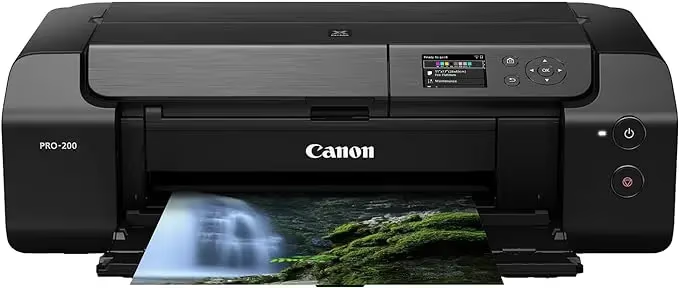
It prints up to 13 x 19 inches, so you can fit multiple sticker designs on a single sheet and cut them apart. The downside is ink cost. Canon’s ChromaLife 100+ cartridges run about $15-20 each, and you’ll replace them frequently at high volumes.
#Best for Vinyl Stickers: Epson SureColor P900
The SureColor P900 is built for professional output. Its 10-color archival pigment ink system produces prints rated to last 200+ years under glass. That’s overkill for stickers, but it means your vinyl stickers won’t fade even after years of outdoor exposure.
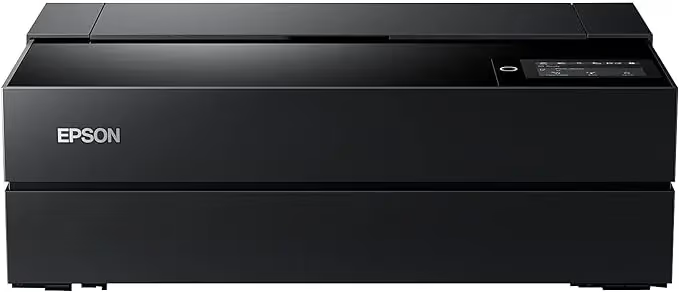
According to Epson’s SureColor specs, it handles rolls and sheets up to 17 inches wide with automatic switching between photo black and matte black ink channels. At $900+, this is for businesses printing premium stickers at volume.
#Best for Waterproof Labels: Brother QL-810W
The Brother QL-810W is a dedicated label printer that prints up to 110 labels per minute. It’s not for decorative stickers but excels at product labels, shipping labels, and barcodes on waterproof DK rolls.
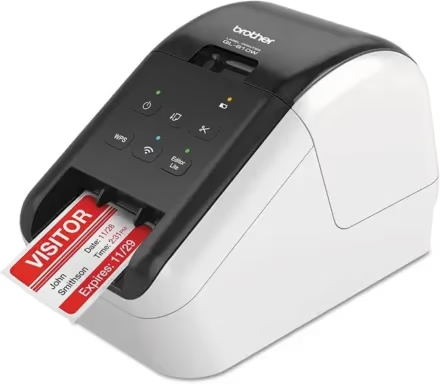
For more on waterproof printing, see our detailed waterproof label printer guide.
#Choosing the Right Sticker Printer
The right printer depends on your volume and sticker type. Here’s what matters most:
Print resolution determines how sharp your stickers look. At 1200 DPI, fine lines and small text stay crisp. Below 600 DPI, detailed artwork gets visibly pixelated on close inspection. All five printers on our list meet the 1200 DPI minimum.
Ink type affects durability. Pigment inks resist water and UV fading for outdoor stickers. Dye inks produce brighter colors but fade faster. A pigment-ink sticker on an outdoor surface holds its color for many months, while a dye-ink version on the same surface starts yellowing far sooner.
Media handling matters if you’re printing on thick vinyl or specialty sheets. Not all printers can feed 0.3mm vinyl stock without jamming. The Epson EcoTank and Canon PIXMA feed thick media reliably, while budget models like the HP ENVY jam more often with stiff vinyl.
#What Paper and Ink Work Best for Stickers?
| Material | Best For | Durability | Printer Compatibility |
|---|---|---|---|
| Glossy vinyl | Die-cut stickers, outdoor use | 3-5 years | Inkjet only |
| Matte paper | Craft stickers, planners | 1-2 years indoor | Inkjet and laser |
| Holographic | Premium stickers, packaging | 2-3 years | Inkjet only |
| Waterproof synthetic | Product labels, bottles | 5+ years | Laser and thermal |
According to Tom’s Guide printing roundup, inkjet printers remain the preferred choice for creative applications including sticker printing. Glossy vinyl is the most popular sticker material because it resists water, scratches, and UV rays. Printed on weatherproof glossy vinyl with pigment ink, sticker artwork survives sustained direct rain without smudging.
#Making Stickers Last Longer
Three steps make a significant difference:
- Apply clear laminate after printing. A $35 cold laminator adds a protective layer that blocks UV, moisture, and scratches. This single step can extend sticker life from 1 year to 5+ years outdoors.
- Use pigment inks for anything going outdoors. Dye inks look brighter initially but fade 3-4x faster under sunlight.
- Let prints dry completely before handling. Waiting about 24 hours before cutting prevents smudging. Cutting immediately after printing can cause ink transfer along the edges.
For design tips, learn how to remove emojis from pictures to clean up source images, or use a shadow removal app for cleaner sticker artwork.
You can also find free LINE stickers for design inspiration, and if your Epson starts streaking mid-batch, our Epson printer troubleshooting guide walks through the most common fixes.
#Bottom Line
Get the Epson EcoTank ET-3850 if you’re printing stickers regularly. Its refillable ink system and 4800 DPI output cover most needs at the lowest running cost. For premium quality on glossy vinyl, the Canon PIXMA PRO-200 produces noticeably better gradients and color depth. The Brother QL-810W is the right pick only if you need high-speed product labels.
#Frequently Asked Questions
Do I need a special printer for stickers?
You don’t need a dedicated sticker printer for small batches. Any inkjet printer with at least 1200 DPI and support for thick media works fine. Dedicated label printers like the Brother QL-810W are only worth it for high-volume product labeling.
Is inkjet or laser better for sticker printing?
Inkjet is better for most sticker work. Dye and pigment inks bond well with vinyl and glossy media, producing rich, saturated colors. Laser printers work for matte paper labels but can’t handle thick vinyl and tend to produce duller colors on glossy stock.
How can I make my stickers waterproof?
Print on waterproof vinyl sticker paper using pigment-based inks, then apply a clear laminate overlay. Laminated vinyl stickers can survive dishwasher cycles and outdoor rain without damage.
What DPI do I need for sticker printing?
1200 DPI minimum for stickers with detailed artwork or small text. At 600 DPI, fine lines start looking fuzzy at normal viewing distance. For photographic stickers, 2400+ DPI produces visibly sharper results.
How much does it cost to print stickers at home?
With the Epson EcoTank, ink costs about 1 cent per page. Sticker paper runs $0.10-0.30 per sheet depending on material. A sheet of 12 stickers costs roughly $0.15-0.35 total, compared to $1-3 per sheet from commercial printers.
Can I use a Cricut with these printers?
Yes. Print your designs on sticker paper using any of these inkjet printers, then use a Cricut Maker or Explore to cut the shapes. This Print Then Cut workflow works well with the Epson EcoTank and Canon PIXMA.

Best Laptop for Running LLMs in 2026: Memory Comes First
The best laptop for running LLMs is a memory purchase first. Compare MacBook unified memory against NVIDIA laptop VRAM, and see what each tier really runs.
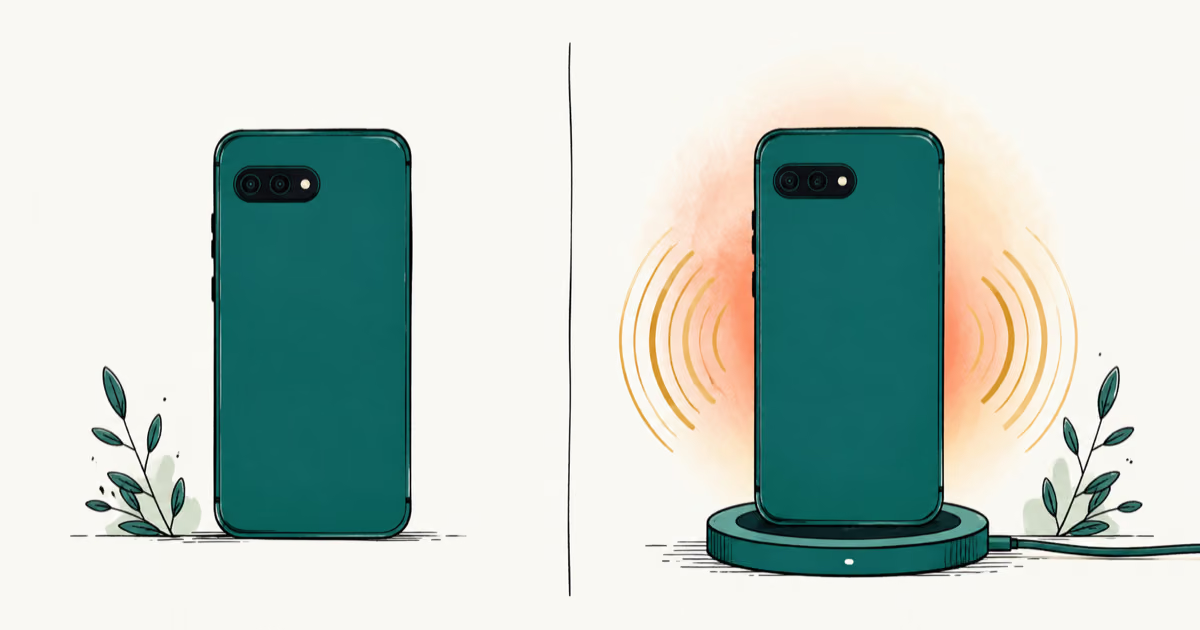
Pixel 11 vs Pixel 10: What Changed and Who Should Upgrade
Pixel 11 vs Pixel 10: same screen and camera resolution, new Tensor G6, 25W wireless, and Gemini Intelligence. Here is who should actually upgrade.
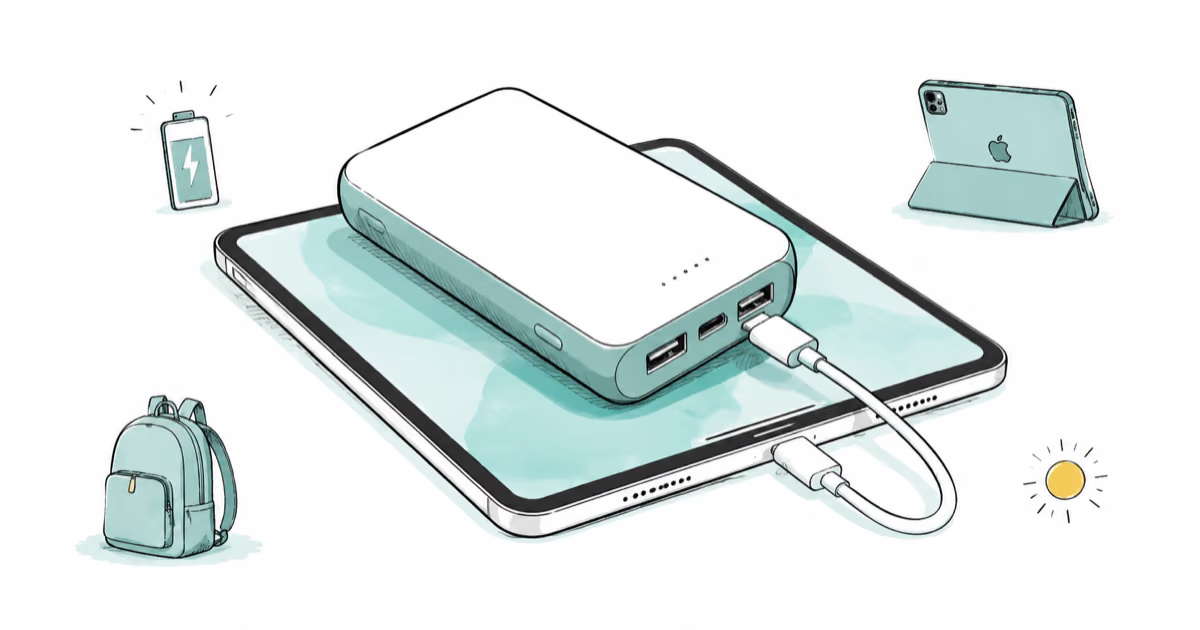
Best Power Bank for iPad in 2026: Pro, Air, and Mini
Best power bank for iPad in 2026. Compare mAh tiers and USB-C PD wattage for iPad Pro, Air, and mini, plus airline Wh math, cables, and travel tips.
Best Power Bank With Built-In Cable: Top 2026 Picks
Best power bank with built-in cable picks for 2026. Compare single USB-C, multi-connector, and retractable laptop banks, plus airline Wh math.