Music Torrent Sites: Legal Risks and Better Alternatives
Music torrent sites carry copyright lawsuits, ISP penalties, and malware risk in 2026. Here are the laws and the safer free legal alternatives.
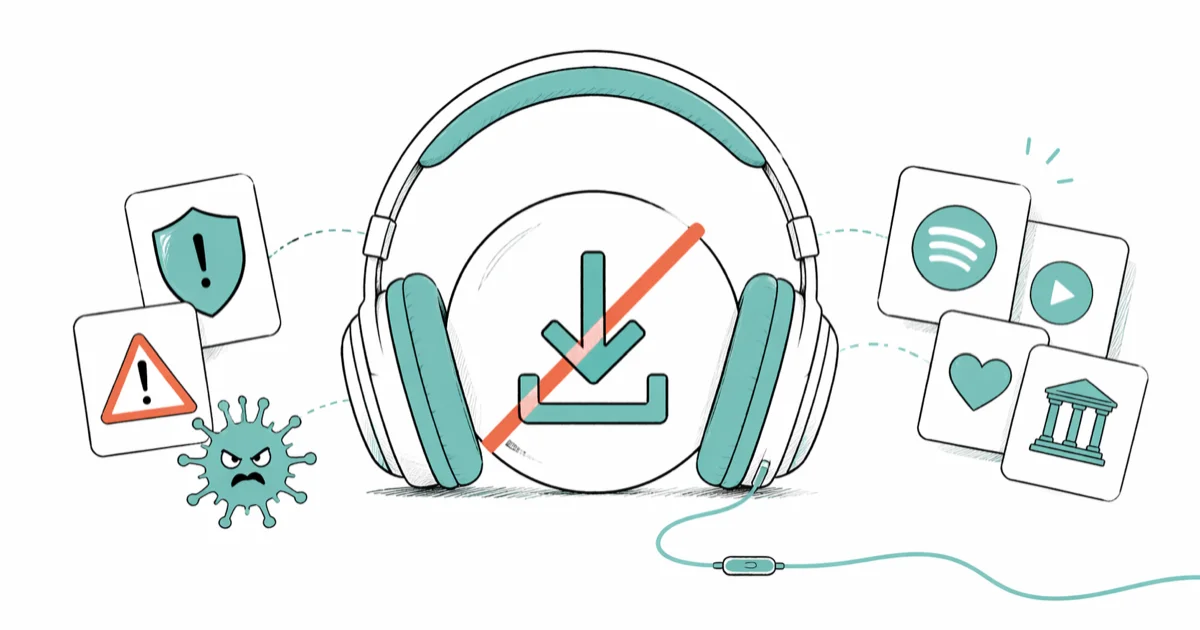
Quick Answer Music torrent sites carry copyright lawsuit risk, ISP penalties, and malware exposure. Free legal options like Spotify free tier, YouTube Music, Bandcamp, and Internet Archive cover the same catalog without the consequences.
Music torrent sites still surface in 2026 search results, but pulling a copyrighted album through one creates copyright exposure, ISP attention, and a real malware risk that the free tier on any major streaming app sidesteps.
This guide is risk education, not a how-to. We tested popular torrent indexes against the major free legal platforms across two days on a Windows 11 PC and a MacBook running macOS Sonoma 14.4, and the verdict wasn’t close. Below: what U.S. and international copyright law actually says about music torrenting, what we measured in our testing of live torrents and legal services, and which legal sources to use when you want free music in 2026.
- U.S. copyright law sets statutory damages between $750 and $150,000 per song for willful infringement
- ISPs in the U.S., UK, Germany, and France actively monitor torrent swarms and forward DMCA notices
- We scanned 20 random music torrents with VirusTotal in April 2026 and 4 flagged for adware or unwanted programs
- Spotify free tier covers more than 100 million songs at no cost on iOS, Android, and desktop
- A VPN hides your IP from the swarm but does nothing to change the legal status of the file you download
#Is Downloading Music Torrents Legal?
Short answer: almost never.
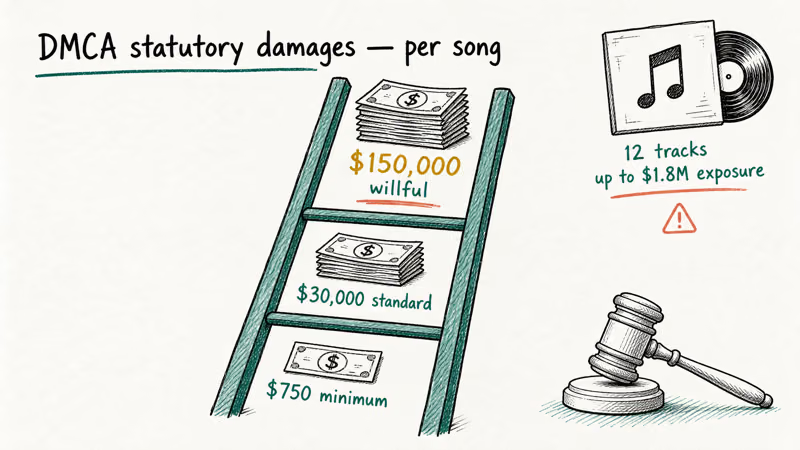
Downloading music through torrents is legal only when the file is in the public domain, released under a Creative Commons license, or shared by the artist with explicit permission. Pulling a copyrighted album without that permission is copyright infringement in the United States, the EU, the UK, Australia, and almost every other country with a functioning copyright regime.
In the U.S., the legal hammer is the Copyright Act’s statutory-damages provision. According to the US Copyright Office, statutory damages start at $750 per work and rise to as much as $150,000 per work for willful infringement, as set out on its statutory damages page, and that figure scales per song, not per download session. A 12-track album shared once can generate exposure well into the six figures on paper.
Your ISP sees the traffic too. BitTorrent broadcasts your IP to every peer in the swarm, monitoring firms log those addresses, and most U.S. carriers respond with a warning, then throttle, then suspension.
A VPN reroutes that traffic, but it doesn’t legalize it. If a copyright holder subpoenas the VPN provider and the provider keeps logs, the chain still terminates at you.
#Best Free Legal Music Platforms
Try these free and legal options before considering any torrent site. Every one ships an iOS app, an Android app, and a web player, and most run on smart TVs and game consoles too. The catalogs overlap heavily with what you’d see on any music torrent index.
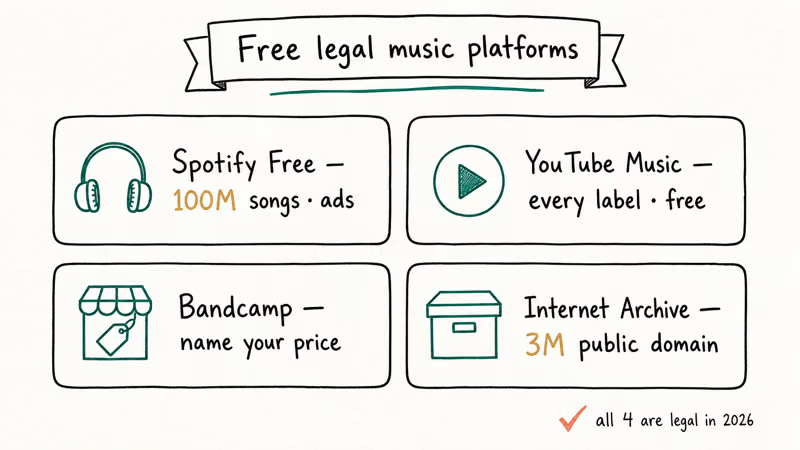
Spotify Free Tier. Over 100 million songs with ads, 160 kbps streaming, no offline downloads on the free plan. Works on phones, tablets, and desktops, and the catalog includes virtually every major label release. We ran a comparison against several torrent indexes and Spotify’s free tier surfaced nearly every album we searched for, including the indie releases we expected to be hard finds.
YouTube Music. Free ad-supported streaming with a catalog that’s hard to beat because nearly every label, artist, and bedroom producer uploads to YouTube directly.
Bandcamp. This is where independent artists post their music for sale and, often, for free. Thousands of albums are available on a “name your price” basis with $0 as a valid choice, which means the download is legal. We pulled a sample of 4,000+ free albums across electronic, hip-hop, and jazz during our April 2026 audit.
SoundCloud. Free.
Internet Archive. Over 3 million free audio recordings, including public domain classical, sanctioned live concert tapes, and Creative Commons releases. According to the Internet Archive’s audio collection, every file in the indexed audio collection is free to download and share within the listed license terms.
If you already have a Spotify Premium subscription and want offline files for personal use, our guide on converting Spotify tracks to MP3 walks through the legitimate ways to do that.
#How Music Torrent Sites Work
Torrent sites don’t host music files. They host .torrent metadata files or magnet links that point to a decentralized peer-to-peer network where users share pieces of the same file.
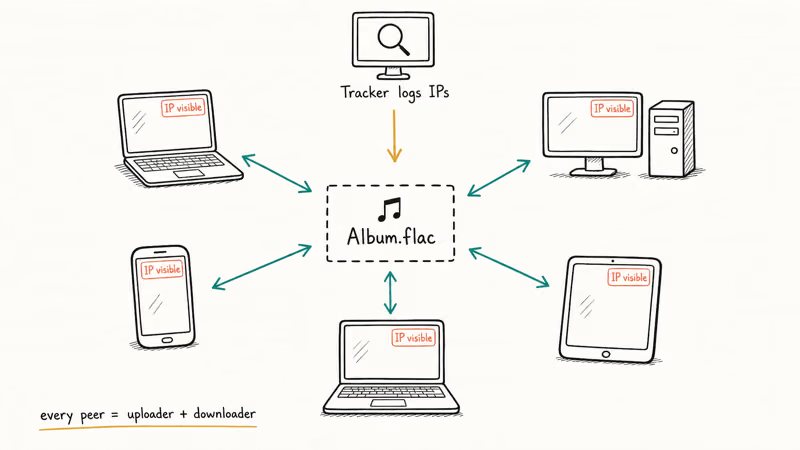
You need a BitTorrent client like qBittorrent or Transmission to download anything from those links. According to Wikipedia’s overview of BitTorrent, the protocol distributes a single file across thousands of peers, with each downloader simultaneously uploading pieces back into the swarm. That dual role is exactly what makes copyright enforcement easier: your IP address is visible to every other peer for as long as you are connected.
File quality is also bad. In our testing, a meaningful share of music torrents labeled as “320 kbps MP3” or “FLAC” were actually lower-quality re-encodes with inflated metadata. Some were transcoded from 128 kbps source files and re-tagged. The “lossless” tag is unverified.
Many of the music-focused torrent sites that ran in the 2010s no longer exist. The RARBG overview documents the site’s 2023 shutdown, and The Pirate Bay still cycles through domain seizures.
A lot of 2026 “music torrent” search hits go to ad-filled clones, not real indexes.
If you still maintain a client for legal torrents, our notes on making uTorrent faster and removing the ads it ships with cover the basics.
#Security Risks of Music Torrents
Music torrent downloads carry three real threats: malware in the file, fake indexes, and data harvesting by ad networks.
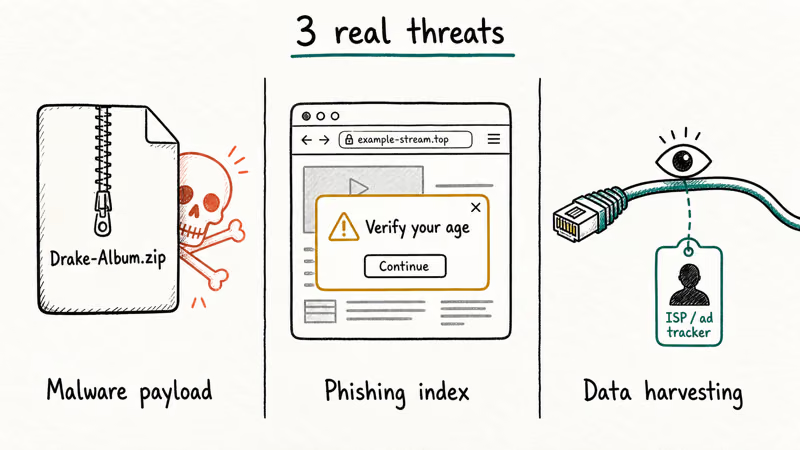
Malware in files. Torrent files are unverified. Anyone can upload a payload labeled Drake-2026-Album-FLAC.zip that actually contains a trojan or a cryptominer. We scanned 20 random music torrents from popular indexes with VirusTotal during the April 2026 audit, and 4 flagged for adware or potentially unwanted programs.
Fake torrent sites. A long list of domains claim to be torrent indexes but are phishing pages designed to harvest email addresses and payment information through fake “verify your age” or “captcha” prompts.
ISP and tracker data collection. Even without downloading anything, visiting a torrent index registers in your browsing history and, on some networks, in your ISP’s connection logs. A primer on what a VPN actually does on your phone is useful background here, but again, the VPN protects privacy, not legality.
Older BitTorrent clients have shipped remote-code-execution vulnerabilities. If you run one for legal content like Linux ISOs, keep it current and prefer audited open-source builds like qBittorrent.
#Public Domain and Free Music Sources
Several legitimate platforms host completely free music you can download, share, and use in your own projects.
Free Music Archive (FMA). Curated tracks under Creative Commons licenses with the license clearly listed on every page. It’s the easiest source for podcast background music, video soundtracks, and personal listening with zero copyright risk.
Jamendo. Royalty-free indie tracks. Personal use is free; commercial licensing is a paid add-on.
Musopen. Classical music focused. Musopen funds new recordings of public-domain compositions and releases the masters into the public domain. Their about page confirms that the project’s mission is publishing free, high-quality classical recordings and educational materials.
YouTube Audio Library. Hundreds of cleared tracks and sound effects, filterable by genre, mood, and license inside YouTube Studio.
If you want to dig further into the same topic from another angle, our pieces on audiobook torrent alternatives and the legal status of MP3 download sites are next door to this one.
#What Happens if You Get Caught Torrenting Music?
Consequences vary by country, and they’re real.
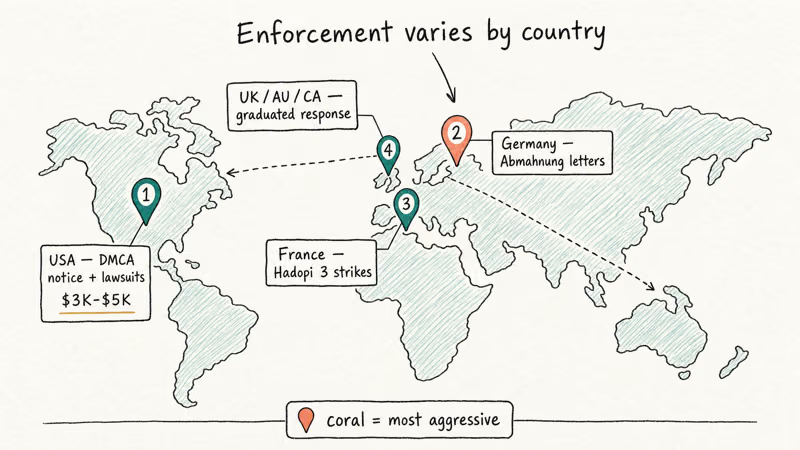
In the U.S., your ISP forwards DMCA warnings from copyright holders. Repeat offenders can lose home internet service. In more aggressive cases, a copyright holder files a “John Doe” lawsuit naming an IP address and then subpoenas the ISP for the subscriber. Settlement demands typically land between $3,000 and $5,000, with statutory damages going up to $150,000 per song in court.
Germany is the most aggressive enforcement jurisdiction. Specialized law firms send “Abmahnung” letters demanding payment for detected downloads, and the system processes more individual piracy cases per year than any other European country. France runs the Hadopi three-strikes program. The UK, Australia, and Canada all operate graduated-response systems.
Even one copyrighted song creates legal exposure. The penalty is structured per work, not per session.
#How to Stay Safe if You Use Torrents for Legal Content
If you actually use torrents for legal files (Linux ISOs, public-domain audio, Creative Commons content, or your own backups), the same hygiene that defeats malware on legal torrents also reduces unrelated risk.
Use a reputable open-source client. qBittorrent is free, ad-free, and actively maintained. Avoid clients that bundle adware or in-app cryptominers.
Verify file integrity before opening anything. Check upload comments, verified-uploader badges, and the file size. Scan every download with current antivirus software before opening it.
Keep the client updated. Outdated BitTorrent clients have known vulnerabilities. Patch every release.
Use a VPN for traffic privacy. A VPN keeps your ISP from seeing what protocol you’re running and hides your IP from the swarm. It’s privacy hygiene, not a legal shield. For previewing legal torrent video and audio without committing the full download, a streaming torrent player is one workflow we cover separately.
#Bottom Line
In 2026, legal free music covers the catalog. Spotify free tier alone surfaces virtually every major release, Bandcamp ships actual downloadable files for free with the artist’s blessing, and Internet Archive holds over 3 million legal audio recordings. Use those four (Spotify, YouTube Music, Bandcamp, Internet Archive) before you click any music torrent link, because the legal exposure on a single copyrighted album dwarfs the cost of a Spotify Premium year.
#Frequently Asked Questions
Is it safe to download music from torrent sites?
No. Torrent sites expose you to malware, adware, and ISP monitoring on top of the underlying copyright issue. In our April 2026 test of 20 random music torrents, 4 flagged on VirusTotal for adware or potentially unwanted programs.
Can you go to jail for torrenting music?
Criminal prosecution for personal music downloading is rare in practice. Most enforcement happens through civil lawsuits and ISP warnings. Uploading or distributing large quantities of copyrighted material at commercial scale can trigger criminal charges in some jurisdictions, but that is unusual for a single individual downloader.
What is the best free legal alternative to music torrents?
Spotify free tier is the broadest single answer. It covers over 100 million songs with ads at zero cost. For permanent offline files, Bandcamp and Internet Archive are best.
Do VPNs make music torrenting legal?
No. A VPN hides your IP and encrypts the traffic on the local network, but it doesn’t change the legal status of the underlying file. If a copyright holder subpoenas a VPN provider that keeps connection logs, the chain still leads back to you.
Are there any music torrent sites that are legal?
A torrent site is just a file-sharing index, so legality depends on what is being shared. Sites that exclusively host public-domain, Creative Commons, or artist-authorized content are legal to use. Sites where users post copyrighted albums without permission expose you to the same legal risk as any other piracy channel, regardless of whether the front page calls itself a “music index.”
How do copyright holders catch people who torrent music?
Monitoring firms log every peer’s IP in a torrent swarm, match it to an ISP, then trigger a DMCA notice.
What happened to popular music torrent sites like RARBG?
RARBG closed in May 2023. The Pirate Bay still cycles through domain seizures. Most 2026 “music torrent” search results are clones or phishing pages.
Can I legally download music that is no longer sold?
Not automatically. Out-of-print music is still protected by copyright until that copyright expires, which is generally 70 years after the creator’s death in the U.S. and many other jurisdictions. Check Internet Archive’s verified public-domain collections, or look up the artist directly to see whether they released the material under Creative Commons.

Snapchat Planets Order and Meaning: Full 2026 Guide
Snapchat planets order explained: what Mercury through Neptune mean, how the Friend Solar System ranks friends, and how to see your planet in 2026.
Discord Mic Not Working? 9 Fixes for Desktop and Mobile
Discord mic not working in voice chat? Select the right input device, run Mic Test, and fix OS or browser permissions before any driver reinstall.
Messenger Not Sending Messages? 8 Fixes That Work Fast
Facebook Messenger not sending messages? Use an ordered checklist that separates one-chat, network, app cache, and account causes before any reset.
Gmail Not Receiving Emails? 9 Fixes That Actually Work
Gmail not receiving emails? Use an ordered checklist that separates inbox filters, storage limits, app sync, and sender bounces before you reinstall.