Best Noise Gate Pedals for Guitar: Top 5 Picks (2026)
The 5 best noise gate pedals for guitar ranked by noise reduction, tone preservation, and value, with picks for high-gain amps and distortion setups.
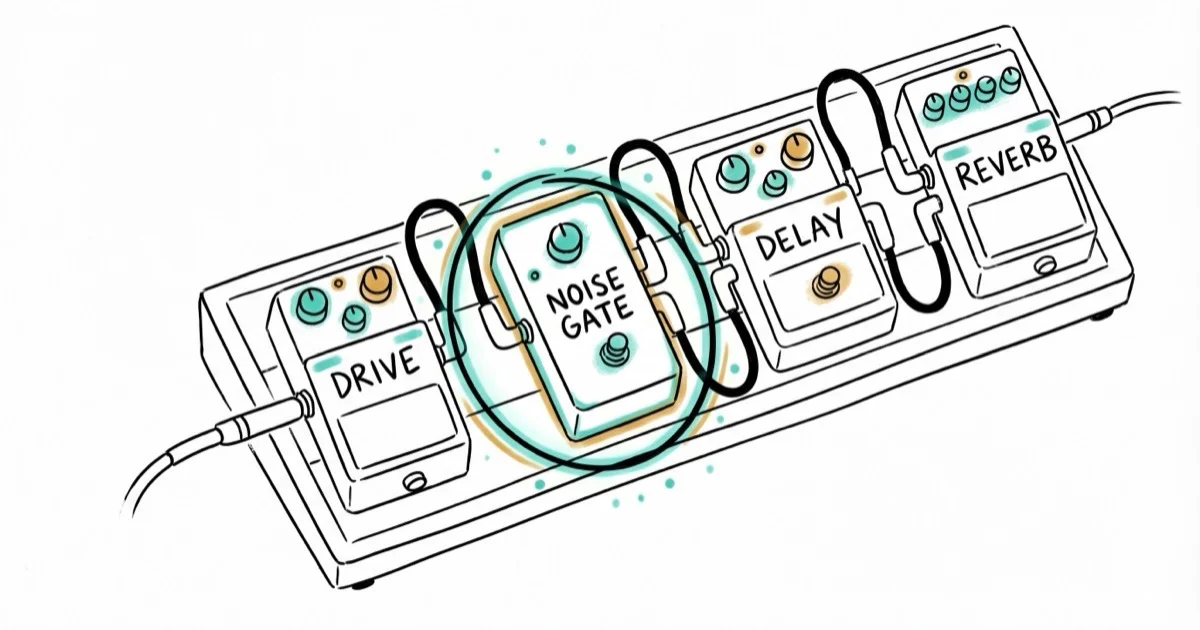
Quick AnswerThe ISP Technologies Decimator G-String II is the best noise gate pedal. Its patented tracking circuit preserves note sustain while cutting unwanted hum, and it works well with high-gain amps and heavy distortion pedals.
Noise gate pedals kill the buzz, hum, and hiss that come with high-gain guitar rigs. This guide ranks five of the most popular models by how well they handle real-world noise problems on high-gain amps like the Marshall JCM800 and Mesa Boogie Dual Rectifier without eating your tone.
Use noise-gate setup tips only for your own device, pedalboard, studio, or authorized venue equipment. Gates can affect microphones, monitors, and recorded tracks, so keep changes within legal privacy boundaries, follow local recording consent rules, and ask the performer, engineer, or owner before altering shared signal chains or show presets.
- The ISP Technologies Decimator G-String II is the best overall pick for high-gain setups thanks to its patented tracking circuit
- The TC Electronic Sentry offers the most customization with multi-band gating and TonePrint technology
- The Boss NS-2 is the budget-friendly standard at around $100 with proven reliability across decades of touring
- Noise gates work by muting your signal when it drops below a threshold you set, cutting noise between notes and riffs
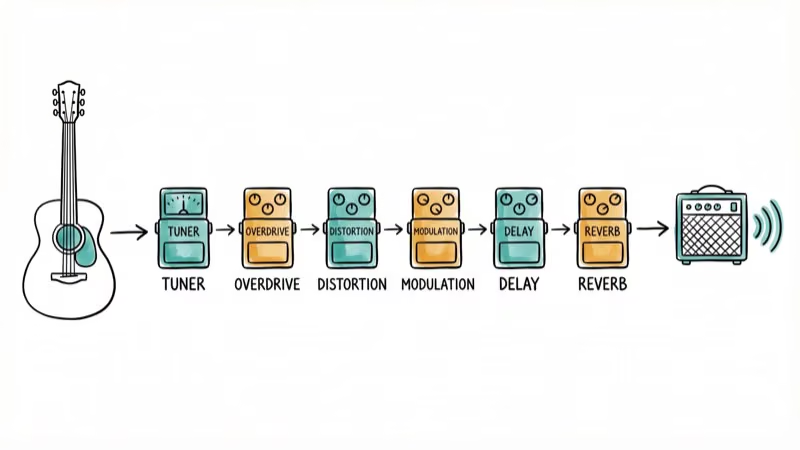
- Place your noise gate after distortion and overdrive pedals but before delay and reverb for the cleanest results
#How Noise Gate Pedals Work
A noise gate monitors your guitar signal level.
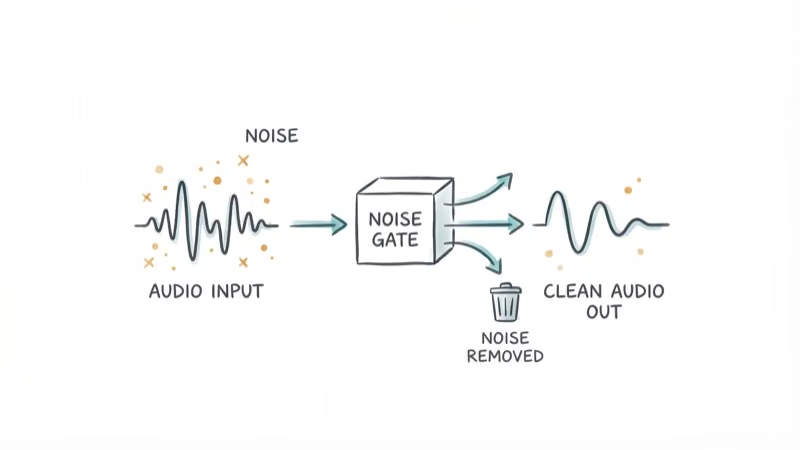 When you’re playing, the signal stays above the threshold you’ve set and passes through unaffected. The moment you stop playing and the signal drops below that threshold, the gate closes and mutes the output. That kills the hiss and hum that high-gain amps and distortion pedals generate between notes.
Four controls determine how the gate behaves. Threshold sets where the gate opens and closes. Attack controls how fast it opens when you start playing. Release/decay determines how gradually it closes after you stop. Reduction adjusts how much the signal drops when the gate is closed.
According to Sweetwater’s noise gate guide, most guitarists should place noise gates after gain-heavy effects and before ambient effects like delay and reverb in their signal chain. This catches noise from distortion pedals while preserving the natural decay of time-based effects.
#Top 5 Noise Gate Pedals Ranked
#1. ISP Technologies Decimator G-String II
The gold standard for high-gain guitarists. On a high-gain amp like a Mesa Boogie, the Decimator kills audible hum without chopping off note sustain. Most cheaper gates cut your sound abruptly, but ISP’s patented tracking circuit follows your playing dynamics.
It uses a separate guitar input for more accurate signal tracking and has true bypass switching. The downside is the price (around $200) and a slightly complex setup with the dual-cable routing.
Best for: Professional musicians, recording studios, and anyone running high-gain amps. According to Reverb’s pedal marketplace data, the Decimator G-String II consistently ranks among the top 3 best-selling noise gates.
As an Amazon Associate, fone.tips earns from qualifying purchases. Some links on this page are affiliate links.
#2. TC Electronic Sentry
The Sentry stands out with multi-band gating that targets specific frequency ranges instead of gating your entire signal at once. This means it can kill high-frequency hiss without affecting your low-end rumble, or vice versa.
TonePrint technology lets you download custom gate settings from professional guitarists via the TC Electronic app. The built-in effects loop adds even more flexibility. It handles everything from clean single-coil hiss to full metal gain saturation.
Best for: Guitarists who want precise control over their noise gate behavior. The learning curve is steeper than simpler pedals.
#3. Boss NS-2 Noise Suppressor
The NS-2 has been on pedalboards since 1987. It’s not the most advanced gate, but it’s reliable, affordable, and easy to use. Two knobs (threshold and decay) plus a built-in effects loop cover the basics without overwhelming beginners.
Some users report slight tone coloration compared to the Decimator or Sentry, but for live performance at moderate gain levels, most players won’t notice. It performs well enough for everything below extreme metal territory.
Best for: Players who want a straightforward, proven noise gate under $100. Complements an audio compressor in the signal chain for cleaner dynamics.
#4. MXR Smart Gate
MXR’s approach uses three selectable frequency ranges (HISS, MID, FULL) so you can target specific noise types. The trigger and release controls are intuitive. It’s especially effective with single-coil pickups that produce audible 60-cycle hum.
It preserves dynamics better than the Boss NS-2 at a similar price point. The compact housing fits tight pedalboards. According to Guitar World’s buyer’s guide, the Smart Gate is a top recommendation for players who switch between clean and dirty tones frequently.
Best for: Guitarists who need targeted noise reduction without affecting playing dynamics.
#5. Electro-Harmonix Silencer
The best value on this list. Threshold, reduction, and release controls plus a built-in effects loop and true bypass in a sturdy enclosure, all for under $80. It handles moderate-gain setups well, though it struggles slightly with the extreme gain levels where the Decimator excels.
Some users report a minor volume drop when the pedal is engaged. For bedroom players, practice rigs, and moderate gain levels, it punches above its price class.
Best for: Budget-conscious guitarists who still want a versatile noise gate with an effects loop.
#What Should You Look for in a Noise Gate Pedal?
Noise reduction vs. tone preservation is the core tradeoff. Aggressive gating kills more noise but can chop your sustain. Premium pedals like the Decimator G-String II solve this with advanced tracking circuits. Budget pedals require more careful threshold and release adjustments.
An effects loop lets you place noisy pedals inside the gate’s detection circuit for more accurate gating. The Boss NS-2, TC Electronic Sentry, and Electro-Harmonix Silencer all include this feature.
True bypass means the pedal doesn’t color your tone when it’s turned off. The Decimator and Silencer both offer true bypass. The Boss NS-2 uses buffered bypass, which can help with long cable runs but adds a slight signal change.
Budget options like the Behringer NR300, Donner Noise Killer, and Rowin Noise Gate get basic noise reduction done for under $40. They lack the advanced features of the pedals above, but they’ll clean up a practice rig or small gig setup. A quality guitar power amp paired with a noise gate makes the biggest difference in your overall tone.
Monitoring through a pair of Bluetooth headphones under $100 helps you hear subtle noise artifacts that speakers might mask. A portable Bluetooth speaker under $50 works well for testing your rig in rehearsal spaces.
#How to Set Up a Noise Gate for Best Results?
Start with the threshold low and raise it gradually while playing.
 You want the gate to close during silent pauses but stay open while you’re playing. If notes cut off prematurely, the threshold is too high.
Set the release long enough to preserve natural note decay. For metal and djent, shorter release times tighten rhythmic playing. For lead work with sustained bends, longer release prevents unnatural cutoffs.
If your pedal has an effects loop, place distortion, overdrive, and fuzz pedals inside it. Keep delay, reverb, and chorus after the noise gate. A good ASMR microphone can reveal subtle noise problems in your recording chain that you might miss through speakers.
#Bottom Line
The ISP Technologies Decimator G-String II is the best noise gate pedal for serious guitarists running high-gain setups. The TC Electronic Sentry is the most customizable option. The Boss NS-2 delivers decades of proven reliability at a lower price, and the Electro-Harmonix Silencer is the best value under $80.
#Frequently Asked Questions
Can a noise gate pedal completely eliminate all noise?
No. Noise gates reduce noise to an acceptable level, but they can’t eliminate it entirely without also cutting your desired signal. They work best at muting noise between notes rather than during sustained playing.
Will a noise gate affect my tone?
High-quality gates aim for transparency. Premium models like the Decimator G-String II have minimal tonal impact. Budget pedals may introduce slight coloration, which most players won’t notice in a live mix but might hear in isolated studio recordings.
Where should a noise gate go in my signal chain?
After distortion, overdrive, and fuzz pedals. Before delay, reverb, and modulation effects. If your pedal has an effects loop, place your gain pedals inside it for the most accurate gating.
Can I use a noise gate with acoustic guitar?
Yes, especially with acoustic-electric setups in live settings. Set the threshold lower than you would for electric guitar to preserve the natural resonance and overtones that acoustic guitars produce.
Are software noise gates as good as hardware pedals?
Software gates in DAWs and amp modelers have improved significantly. They work well for recording. Dedicated hardware pedals offer better real-time performance for live playing where latency matters.
Do I need a noise gate if I use a noise suppressor in my amp?
Built-in noise suppressors on modern amps handle light noise. A dedicated pedal gives you more control over threshold, attack, and release settings, which matters for high-gain tones where amp suppressors alone can’t keep up.

Best Laptop for Running LLMs in 2026: Memory Comes First
The best laptop for running LLMs is a memory purchase first. Compare MacBook unified memory against NVIDIA laptop VRAM, and see what each tier really runs.

Pixel 11 vs Pixel 10: What Changed and Who Should Upgrade
Pixel 11 vs Pixel 10: same screen and camera resolution, new Tensor G6, 25W wireless, and Gemini Intelligence. Here is who should actually upgrade.

Best Power Bank for iPad in 2026: Pro, Air, and Mini
Best power bank for iPad in 2026. Compare mAh tiers and USB-C PD wattage for iPad Pro, Air, and mini, plus airline Wh math, cables, and travel tips.
Best Power Bank With Built-In Cable: Top 2026 Picks
Best power bank with built-in cable picks for 2026. Compare single USB-C, multi-connector, and retractable laptop banks, plus airline Wh math.