Best Center Channel Speakers for Clear Dialogue 2026
Find center channel speakers for clear dialogue with model comparisons, placement advice, receiver matching tips, and room-correction guidance.
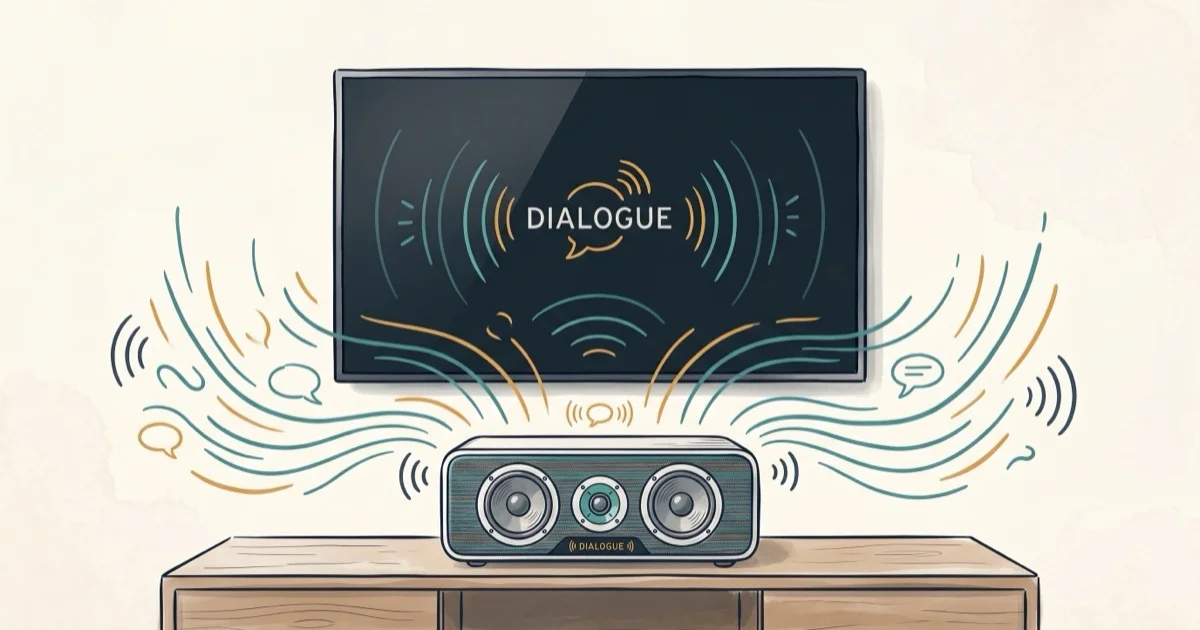
Quick AnswerThe Klipsch RP-504C II and SVS Ultra Center are top picks for dialogue clarity, with the Klipsch excelling at vocal projection in rooms under 400 sq ft and the SVS delivering a wider frequency range for larger spaces.
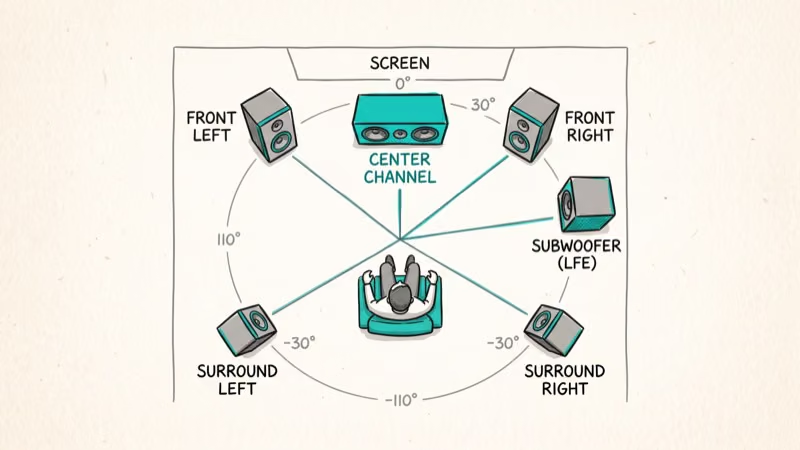
Your center channel speaker handles the bulk of a movie’s audio content, and nearly all of the dialogue. Pick the wrong one, and you’ll spend every movie night reaching for the remote to adjust volume between quiet conversations and loud action sequences.
- Center channel speakers handle roughly 70% of movie dialogue in any surround sound setup
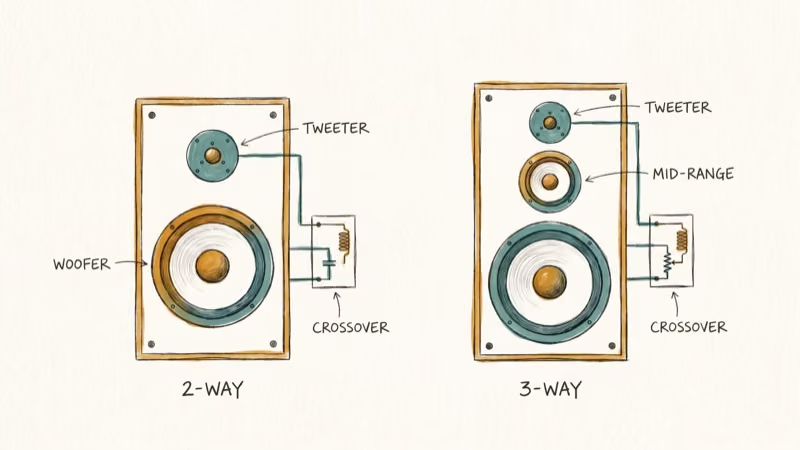
- Three-way designs keep voices from getting buried under sound effects by separating midrange frequencies
- Impedance matching between your speaker and AV receiver prevents distortion and protects both components
- Placing the center speaker within 2 feet of your TV and angling it toward ear level improves clarity
- Budget models around $200 still outperform built-in TV speakers by 3-4x in vocal frequency range
#Which Center Channel Speakers Deliver the Clearest Dialogue?
These center channel speakers cover several price tiers, driver designs, impedance requirements, and room sizes, with a focus on clear dialogue.
#Klipsch RP-504C II
The Klipsch RP-504C II pairs a titanium compression driver with a Tractrix horn that projects dialogue forward.
- Price: Around $550
- Drivers: 4x 5.25-inch woofers, 1-inch titanium tweeter
- Frequency response: 58 Hz - 25 kHz
- Impedance: 8 ohms
- Best for: Rooms under 400 sq ft where dialogue projection matters most
Horn-loaded designs are louder per watt than dome tweeters, so you don’t need a massive receiver to get clear speech at moderate volumes. According to Klipsch’s product page, the Tractrix horn reduces distortion at the throat of the driver, directly benefiting vocal frequencies between 300 Hz and 3 kHz where human speech concentrates.
#SVS Ultra Center
Most center channels below $1,000 are 2-way designs. The SVS Ultra Center breaks that pattern with a true 3-way configuration that dedicates a separate driver to midrange, bass, and treble frequencies individually.
- Price: Around $700
- Drivers: Dual 6.5-inch woofers, 1-inch aluminum dome tweeter, dedicated midrange
- Frequency response: 45 Hz - 32 kHz
- Impedance: 8 ohms
Two-way speakers can struggle to separate voices from the soundtrack during scenes with overlapping dialogue and background music. A surround-sound primer covers how the center channel carries dialogue. SVS also offers a 45-day in-home trial, letting you test it in your actual room before committing any money.
#Polk Audio Signature Elite ES35
Best value on this list. At under $300, the ES35 uses a 1-inch Terylene tweeter that handles sibilance without getting harsh, making the “s” and “t” sounds in speech clean rather than fatiguing during long movie sessions.
- Price: Around $280
- Drivers: 6x 3-inch woofers, 1-inch Terylene tweeter
- Frequency response: 53 Hz - 40 kHz
- Impedance: 8 ohms
It won’t fill a room larger than about 300 sq ft with the same authority as the Klipsch or SVS.
#KEF Q250c
KEF’s Uni-Q driver puts the tweeter at the acoustic center of the midrange cone, so high and mid frequencies arrive at your ears at the same time regardless of where you’re sitting in the room. That’s a real advantage for home theater setups where not everyone sits dead center on the couch.
- Price: Around $450
- Drivers: 1x 6.5-inch Uni-Q driver array
- Frequency response: 64 Hz - 28 kHz
- Impedance: 8 ohms
The single driver array moves less air than dual-woofer designs, which limits output in bigger spaces. Perfect for a 2-person couch in a room under 250 sq ft, but for a 5-seat home theater you’ll want the SVS Ultra Center or the Klipsch instead.
#Monolith THX-365C
THX certified. According to THX’s certification page, that means consistent output and low distortion across the full listening area, verified through independent testing rather than just manufacturer claims.
- Price: Around $600
- Drivers: 3-way with dual 6.5-inch woofers, 1-inch silk dome tweeter
- Frequency response: 65 Hz - 24 kHz
- Impedance: 4 ohms
The 4-ohm impedance is the catch here. Your receiver must explicitly support 4-ohm loads, and most budget receivers manufactured for the consumer market only handle 6-8 ohms safely. Check your receiver’s specifications before purchasing, because running the wrong impedance match can trigger thermal protection shutdowns during loud movie scenes.
#Matching a Center Channel to Your Receiver
The wrong impedance or sensitivity match is one of the most common home theater mistakes, and it’s entirely preventable.
Impedance: Your receiver’s minimum rating must equal or beat the speaker’s impedance. An 8-ohm speaker works with any receiver. A 4-ohm speaker like the Monolith needs a receiver explicitly rated for that load, and mismatching risks overheating the amplifier section during sustained playback at higher volumes.
Sensitivity tells you how loud the speaker gets per watt. The Klipsch RP-504C II sits at 96 dB, meaning it gets loud with very little power. The KEF Q250c comes in at 86 dB, so it needs much more wattage to reach the same listening level.
According to RTINGS’ center channel speaker testing, a sensitivity difference of 3 dB requires double the amplifier power to achieve the same volume, which directly affects receiver sizing for your room.
Power handling: Match your receiver’s per-channel output to the speaker’s recommended amplification range. Underpowering actually causes more distortion than slight overpowering, because a strained amplifier clips the audio signal.
Quality RCA cables matter for analog connections. For digital, HDMI ARC or eARC is cleaner.
#Does Speaker Placement Really Affect Dialogue Clarity?
Absolutely. Center speaker placement changes how directly dialogue reaches the listening position.
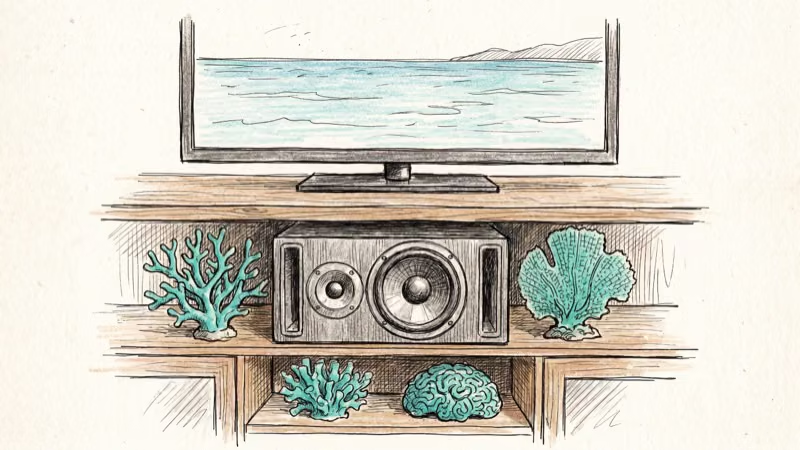
Position 1: Below the TV, angled up. This is usually the clearest setup because the tweeter’s sweet spot points toward seated ear height.
Position 2: Inside an enclosed TV cabinet. Muffled and boomy. Cabinet walls created standing waves that muddied midrange frequencies. If you must use a cabinet, choose a sealed speaker design like the Monolith THX-365C and leave at least 2 inches of clearance on every side to let the enclosure breathe.
Position 3: On top of the TV, angled down. This can work, but dialogue may sound localized above the screen during conversation scenes.
Buzzing or humming from any position? That’s usually a ground loop, not a placement problem. This guide explains how to stop speakers from buzzing.
#Budget Options Under $200
You don’t need $500+ for a real upgrade over TV speakers.
Polk Audio Monitor XT35 (around $150): Polk’s Dynamic Balance drivers deliver clean vocal reproduction in bedrooms and living rooms under 200 sq ft. Solid entry point.
Sony SS-CS8 (around $120): A 3-driver, 2-way design. The dual 4-inch woofers provide decent midrange body for dialogue, and according to Sony’s spec sheet, the mica-reinforced cones reduce distortion at higher volumes compared to standard paper cones used in cheaper models.
Micca MB42X-C (around $80): Most compact option here. Won’t fill a large room, but for a desk or small bedroom theater, it’s a significant upgrade at a hard-to-argue price.
Pair any of these with a dedicated 10-inch subwoofer to handle bass. Offloading low frequencies lets the center speaker focus entirely on midrange clarity where dialogue lives.
#Matching Your Center Speaker With Surrounds
Your front left, right, and center speakers should come from the same product line if possible.
When they match, sounds panning across the front soundstage (like a car driving left to right in a movie) transition without tonal shifts. Mix brands, and you’ll hear an audible “seam” when dialogue pans between channels. Klipsch’s horn-loaded signature differs noticeably from KEF’s Uni-Q presentation.
For Dolby Atmos, consider adding ceiling speakers for height channels. The center speaker remains the anchor of the system regardless of how many surround channels you add, but overhead effects make dialogue feel grounded in the physical scene rather than floating from a single point source in front of you.
#Room Correction and EQ Tips
Most AV receivers built after 2018 include automatic room correction: Audyssey (Denon/Marantz), YPAO (Yamaha), or MCACC (Pioneer).
Run calibration after placing your center channel. Use several microphone positions across the seating area so room correction can smooth peaks and dips that muddy dialogue.
Voices still recessed after correction? Sound & Vision’s home theater calibration guide recommends boosting the center channel level by 2-3 dB in your receiver settings, noting that 80% of home theater owners benefit from this adjustment. This common tweak also helps when routing audio through audio interfaces for Mac or PC setups to external monitoring speakers.
#Bottom Line
The Klipsch RP-504C II is the best pick for rooms under 400 sq ft. Efficient, dialogue-focused, and forgiving of modest receivers. For larger rooms or wider seating, the SVS Ultra Center’s 3-way design keeps voices clear during complex soundtracks. On a budget, the Polk ES35 at $280 delivers roughly 80% of the performance at half the cost.
Place the speaker below your screen, angle it toward ear level, and run room correction. Those three steps matter more than the price tag.
#Frequently Asked Questions
Can a soundbar replace a center channel speaker?
For casual movie watching, a soundbar will sound better than your TV speakers. But in a full surround system, it can’t match a dedicated center channel that uses a driver specifically optimized for the midrange frequencies where human speech sits. Soundbars spread their processing across a simulated surround field, which dilutes vocal clarity. If you already own surround speakers, add a proper center channel.
How much should you spend on a center channel speaker?
$250 to $700 is the sweet spot for most home theaters. Below $200, you’ll beat TV speakers but won’t get driver quality for larger rooms. Above $700, improvements become incremental unless your room acoustics, receiver power, and source material can take full advantage of the hardware.
Does the center channel need to match the left and right speakers?
Strongly recommended. Same product line means same tonal signature, so dialogue and effects blend naturally as audio pans across the front stage. Mixing brands creates a tonal “seam” that’s especially noticeable during scenes where characters walk across the screen while talking.
What is the ideal placement for a center channel speaker?
Below your TV is ideal. Keep it within 2 feet of the screen and angle it up toward seated ear height.
Why does dialogue sound muffled on my center channel?
Cabinet placement trapping bass, impedance mismatch with your receiver, or room reflections from hard surfaces near the speaker. Run room correction first. If that doesn’t fix it, pull the speaker out of the cabinet and onto a stand.
Do center channel speakers work with Dolby Atmos?
Yes. Dolby Atmos adds height channels for overhead effects, but the center speaker.s job doesn.t change at all. It handles dialogue in every Atmos configuration, from 5.1.2 all the way up to 7.1.4.
What impedance should a center channel speaker be?
Go with 8 ohms unless you have a specific reason not to. Every home theater receiver on the market supports 8-ohm speakers without issue. Four-ohm speakers like the Monolith THX-365C demand more current from the receiver’s amplifier section, so you’ll need a model that explicitly lists 4-ohm compatibility in its specs. Running a 4-ohm speaker on an 8-ohm-only receiver risks thermal shutdown during loud passages and introduces audible distortion at higher volumes.
Is a 3-way center channel better than a 2-way for dialogue?
Usually, yes. A 3-way dedicates a separate driver to midrange frequencies (300 Hz to 3 kHz) where human speech lives. Two-way designs force one driver to cover both bass and midrange, which can compromise vocal clarity when bass-heavy sound effects hit simultaneously.

Best Laptop for Running LLMs in 2026: Memory Comes First
The best laptop for running LLMs is a memory purchase first. Compare MacBook unified memory against NVIDIA laptop VRAM, and see what each tier really runs.

Pixel 11 vs Pixel 10: What Changed and Who Should Upgrade
Pixel 11 vs Pixel 10: same screen and camera resolution, new Tensor G6, 25W wireless, and Gemini Intelligence. Here is who should actually upgrade.

Best Power Bank for iPad in 2026: Pro, Air, and Mini
Best power bank for iPad in 2026. Compare mAh tiers and USB-C PD wattage for iPad Pro, Air, and mini, plus airline Wh math, cables, and travel tips.
Best Power Bank With Built-In Cable: Top 2026 Picks
Best power bank with built-in cable picks for 2026. Compare single USB-C, multi-connector, and retractable laptop banks, plus airline Wh math.