12 Best Games Like Path of Exile for ARPG Fans in 2026
Hunt loot with 12 games like Path of Exile. Compare Grim Dawn, Last Epoch, Diablo 4, Torchlight II, Wolcen, and 7 more ARPG picks for 2026 fans.
Quick AnswerGrim Dawn, Last Epoch, and Diablo 2: Resurrected are the closest games to Path of Exile, with deep passive trees, isometric combat, and build variety that extends far past the main campaign.
Burned through Path of Exile’s Atlas and still hungry for loot? The isometric action-RPG shelf has quietly refilled since Grinding Gear Games shipped their first league, and each entry below pulls PoE’s skill-tree-and-currency formula in a different direction. These twelve picks each hold up on PC and most run on a Steam Deck too.
- Grim Dawn pairs a dual-class mastery system with a Victorian-horror setting that feels darker than Wraeclast
- Last Epoch hit 1.0 release in February 2024 and sits between PoE’s depth and Diablo 3’s clarity
- Diablo 4 added an open-world seasonal layer that Path of Exile has never chased
- Torchlight II came from ex-Blizzard North devs and ships as the closest direct Diablo 2 successor
- Warframe, Divinity Original Sin 2, and Pillars of Eternity cover MMO, CRPG, and party RPG niches
#What Makes a Game Feel Like Path of Exile?
Four things separate a Path of Exile alternative from a generic RPG: isometric combat, a deep passive or skill-point tree, colored-rarity loot chases, and a repeatable endgame that goes long past the credits. Games like Skyrim and The Witcher 3 have excellent loot and RPG progression, but they miss the clicker-combat rhythm that defines PoE.
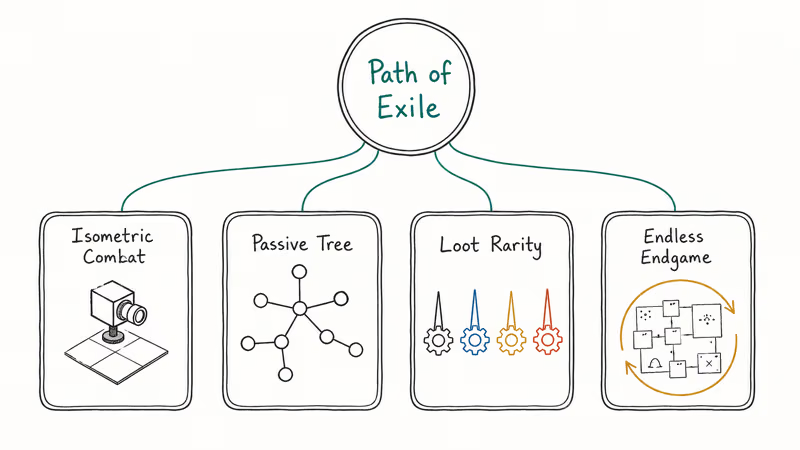
According to Grinding Gear Games’ Path of Exile game overview page, the core PoE loop centers on socketed skill gems, a massive shared passive tree, and a currency system where items reroll gear stats instead of gold. Every pick below either doubles down on one of those pieces or deliberately breaks it.
#The Deepest Path of Exile Alternatives for ARPG Veterans
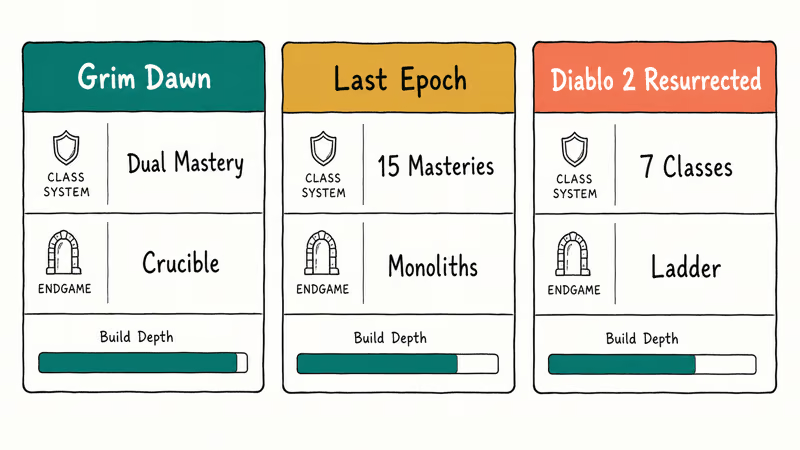
These three are where lapsed PoE players land when they want a game that respects theorycrafting. Build depth is the headline feature of every one of them.
#1. Grim Dawn
Best for: Dark fantasy fans who want a dual-class system.
Grim Dawn came from Crate Entertainment, a studio founded by former Iron Lore developers who shipped Titan Quest. Its signature trick is the dual mastery system. You combine two of six classes (for example, Soldier plus Occultist) into hybrid builds with their own skill synergies, which gives roughly thirty viable archetypes before you count constellations.
The Victorian-horror setting gives it a grimier tone than Wraeclast’s tribal ruins. Crate Entertainment’s Forgotten Gods expansion page confirms the expansion adds new masteries, a new campaign chapter, and the Shattered Realm endgame mode. Hybrid builds like Occultist plus Necromancer lean on the Crucible arena as a main source of legendary gear.
#2. Last Epoch
Best for: Theorycrafters who want crafting clarity without trading with strangers.
Last Epoch hit full 1.0 release in February 2024 after six years of early access. Eleventh Hour Games designed it as a middle ground between Path of Exile’s build depth and Diablo 3’s accessibility. You directly stack affixes onto gear with crafting materials instead of rerolling at random, which means build planning feels deterministic rather than gambled.
The time-travel hook splits the story across five eras of the Eterra timeline. Each of the 15 masteries plays distinctly, so a Void Knight feels nothing like a Runemaster. The Monolith of Fate endgame is a drop-in loop because a single run is short instead of PoE’s longer map tier grinds.
For a side-by-side on PoE versus Last Epoch, our games like Diablo 3 roundup puts both head-to-head.
#3. Diablo 2: Resurrected
Best for: Going back to where the hack-and-slash formula was born.
Diablo 2: Resurrected is Blizzard’s 2021 remaster of the 2000 original, rebuilt with modern 3D graphics but keeping the original engine’s stat formulas and runeword economy. Blizzard’s Diablo II Resurrected features page states that the remaster rebuilt every cinematic from scratch, added shared stash tabs, and added full controller support.
Path of Exile spiritually descends from Diablo 2, so playing Resurrected is going back to the source material. Ladder seasons still run, and runewords remain the cleanest gear progression arc in ARPG history. The remaster’s full controller support makes it a natural fit for the Steam Deck, so it travels well.
#Diablo-Adjacent Picks That Carry the PoE Loot Rhythm
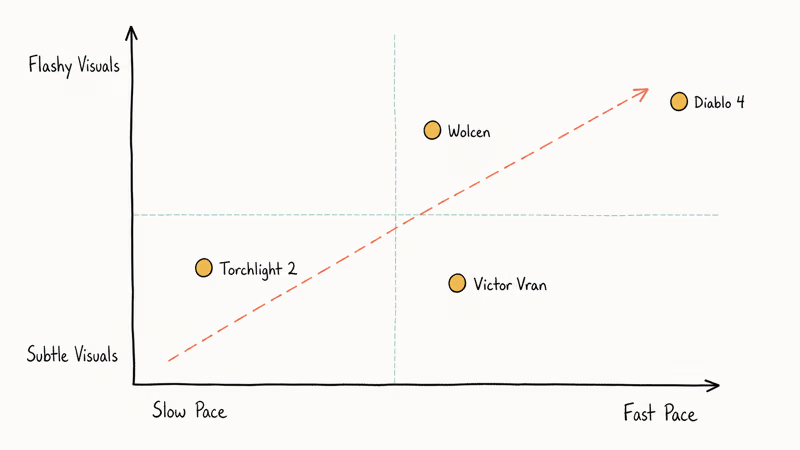
Not everyone wants another thousand-hour passive tree. These four picks keep the loot-combat loop but either add flash, shift the camera, or change the pacing. Pick the one whose vibe matches yours.
#4. Diablo 4
Best for: Players who want an open-world seasonal ARPG with a AAA budget.
Diablo 4 is Blizzard’s 2023 open-world return to Sanctuary. It ships a shared overworld with world bosses, a rotating seasonal battle pass, and mounted traversal between zones. Seasons launch every three months with a fresh mechanic and ladder leaderboard.
Build depth is shallower than Path of Exile’s passive tree. According to Blizzard’s official Diablo IV game page, Diablo 4 launched with five classes (Barbarian, Sorcerer, Rogue, Necromancer, Druid) and added Spiritborn in the Vessel of Hatred expansion. The Paragon board and Pit dungeon system still give endgame players a measurable gear chase, with the seasonal journey running alongside it as a second progression track.
#5. Torchlight II
Best for: Diablo 2 nostalgia with brighter cartoon art.
Torchlight II came from Runic Games, a studio founded by ex-Blizzard North employees. Those are the same devs who shipped Diablo and Diablo II. You’ll feel that lineage in the click rhythm, the loot rarity colors, and the pet that runs loot back to town for you.
Four classes (Embermage, Outlander, Engineer, Berserker) each have three skill trees. Torchlight II’s LAN and internet co-op still works in 2026, and the community mod scene stays active thanks to GUTS, the official editor. The main story runs around 18 hours, with the mapworks dungeons adding replay value after.
#6. Wolcen: Lords of Mayhem
Best for: Cinematic flashy combat over raw build depth.
Wolcen: Lords of Mayhem launched in 2020 with a rocky start and has stabilized through post-launch patches. Wolcen’s hook is pure visual spectacle. Spells paint the screen with particle effects, and the Gate of Fates passive tree rotates into three orbital rings around your character portrait.
It’s less deep than Grim Dawn or Last Epoch once you reach the Champion of Stormfall endgame. The moment-to-moment combat is the prettiest in the genre, though, and the three-act campaign runs short before that endgame opens up.
#7. Victor Vran
Best for: Dodge-roll ARPG pacing without a skill tree.
Victor Vran: Overkill Edition replaces the skill-point grind with a loadout system built around weapon choice and two flexible demon-power slots. Haemimont Games also added a dodge-roll as a core combat verb. That gives Victor Vran an action-game tempo that Path of Exile doesn’t chase.
The Motörhead: Through the Ages DLC is a standout bonus. It’s a full standalone campaign voiced by Lemmy Kilmister. The main campaign runs around 14 hours and supports drop-in couch co-op, so a friend can join part way through.
#Classic and MMO Picks
Three more picks round out the action side of the list.
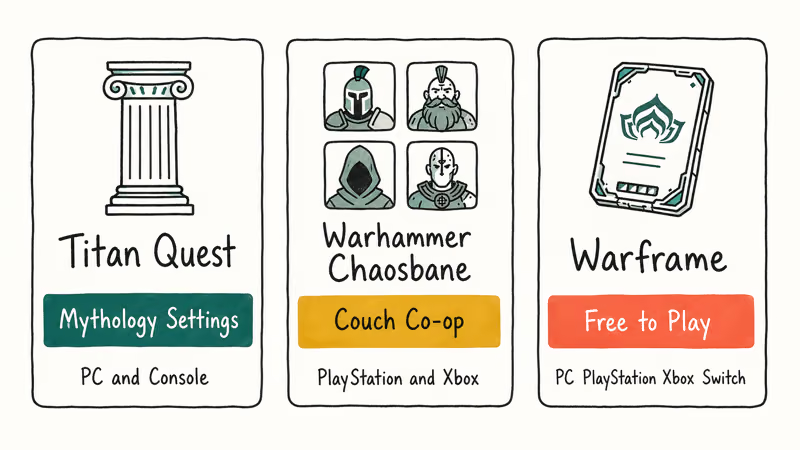
#8. Titan Quest: Anniversary Edition
Best for: Greek and Egyptian mythology settings with dual-class builds.
Titan Quest: Anniversary Edition is the 2016 remaster of Iron Lore’s 2006 original. It pioneered the dual-mastery system Grim Dawn later refined. The Greek, Egyptian, and Asian mythology settings give every region a distinct monster roster, and the Ragnarök and Atlantis DLCs extend the endgame with Norse and Atlantean chapters.
Titan Quest shows its age in UI friction. Inventory management and skill respec feel dated next to Last Epoch. If you can live with that, the mythology worldbuilding is unmatched. Wikipedia’s Titan Quest entry confirms the Anniversary Edition consolidated all original patches, the Immortal Throne expansion, and bug fixes into one package.
#9. Warhammer: Chaosbane
Best for: Warhammer Fantasy fans and four-player couch co-op.
Warhammer: Chaosbane is the only licensed Warhammer Fantasy ARPG on the market. Eko Software built it around four classes tied to the Empire, High Elves, Dwarves, and Wood Elves. Four-player local couch co-op on console is the feature that differentiates it most.
The build depth is shallower than Last Epoch or Grim Dawn, and the loot pool is smaller. If you want to sit on a couch with three friends and a bowl of chips, though, Chaosbane is the Path of Exile replacement console players actually have. The Old World campaign runs around 16 hours in split-screen.
#10. Warframe
Best for: Free-to-play third-person loot-shooter with 400-plus hours of content.
Warframe from Digital Extremes is a sci-fi third-person loot-shooter rather than a pure isometric ARPG, but the gear grind and mod-based build system scratch the same itch. You pilot dozens of space-ninja frames, each with four signature abilities and a mod tree that shapes damage scaling. If shifting to a shooter camera sounds tempting, our games like Warframe list covers deeper alternatives.
Warframe is fully free-to-play with no pay-to-win frame upgrades. You can farm every frame through gameplay, which makes it a low-risk side-grade when your PoE league fatigue sets in. According to Digital Extremes’ Warframe news page, the game ships seasonal updates called Nightwave and a new open world or expansion roughly once a year.
#Narrative and CRPG Alternatives
If the PoE itch is really about loot, skill trees, and fantasy storytelling combined, two narrative RPGs cover the story half better than any action-RPG on this list.
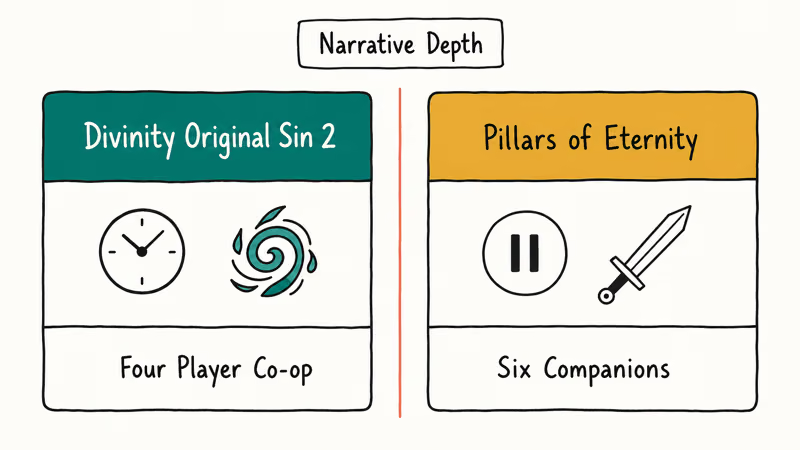
#11. Divinity: Original Sin 2
Best for: Turn-based combat with environmental interaction depth.
Divinity: Original Sin 2 from Larian Studios is the sequel that built the reputation Baldur’s Gate 3 later cashed in. Combat is turn-based instead of real-time, but the build depth, elemental interactions, and loot chases all echo the theorycrafting energy PoE players love.
The environment itself is a weapon. You combine poison clouds with fire to explode enemies, freeze water to walk across it, or teleport bosses into their own traps. A four-player co-op campaign can run well past 80 hours, which says a lot about the content density. The Larian Studios Divinity Original Sin 2 page confirms that the Definitive Edition reworked Act 4, added game master mode, and shipped full controller support.
#12. Pillars of Eternity
Best for: Infinity Engine CRPG feel with a reactive narrative.
Pillars of Eternity from Obsidian Entertainment is the spiritual successor to Icewind Dale, Planescape: Torment, and Baldur’s Gate. You play a Watcher who reads the souls of the dead, and the central mystery pulls you across the Dyrwood to uncover why Hollowborn children are being born without souls.
Real-time-with-pause combat works differently than Path of Exile’s click rhythm. The build depth is still there, though: eleven classes, dozens of talents, six companions with their own arcs, and a reactive conversation system that remembers your choices. If you want a party-based CRPG next, our games like Baldur’s Gate roundup covers the story-driven side. The base campaign runs roughly 60 hours, with The White March expansion adding around 20 more.
#Which Game Like Path of Exile Should You Start With?
Start with Grim Dawn if you want the deepest build depth on a single purchase, Last Epoch if you want modern polish with crafting clarity, or Diablo 4 if you want an open-world AAA seasonal loop. Each of those three hits a different PoE nerve. Between them they cover most of what Path of Exile fans look for when they need a change.
If you’re playing on console, Diablo 4 and Warhammer: Chaosbane are the strongest controller experiences. For something portable with longer sessions, our games like Runescape list covers the MMO-style grind that Warframe opens up.
#Bottom Line
Grim Dawn is the pick if you want the deepest single-purchase ARPG with dark atmosphere. Last Epoch is the pick for modern polish without losing theorycraft headroom, and Diablo 4 is the pick if you want an open-world seasonal loop with AAA production value. Skip Wolcen if raw depth matters more than particle effects, and skip Pillars of Eternity if you want real-time click combat rather than a party-based CRPG.
If none of these land, our games like Ark roundup covers open-world survival picks, and the games like Bloodborne list covers harder action-combat games that still reward gear progression.
#Frequently Asked Questions
Is Path of Exile 2 worth waiting for?
Path of Exile 2 entered early access in December 2024 and shares account progression with the original PoE. If you want the new skill-gem system and slower combat pacing, jump in now. If you want stable leagues and the full passive tree you know, stick with the original.
Can I play these Path of Exile alternatives on Steam Deck?
Most run well. Grim Dawn, Last Epoch, Torchlight II, Victor Vran, and Diablo 2: Resurrected are all Steam Deck-friendly. Diablo 4 technically runs through Battle.net on Deck but expects some battery drain. Grim Dawn is the standout handheld pick because its slower combat pace plays well with Deck triggers.
Which game like Path of Exile has the best free-to-play option?
Warframe is fully free-to-play with no progression paywall. Path of Exile itself is also free-to-play with a cosmetics-only monetization model. Diablo 4 requires the base game purchase but seasons are free after that. Every other game on this list is a one-time buy.
Are any of these games good for solo players?
All 12 work solo. Grim Dawn, Last Epoch, Diablo 2 Resurrected, and Titan Quest are especially friendly because their campaigns scale to one player, never require group content for endgame progression, and let you complete the passive tree and legendary gear collection without ever touching a party system. Divinity Original Sin 2 works solo too, though it shines in four-player co-op where environmental combat tricks multiply quickly.
How long is the Grim Dawn campaign?
Roughly 25 to 35 hours for the base game. Ashes of Malmouth and Forgotten Gods add 20 to 30 more each.
Do any of these games have couch co-op?
Yes. Diablo 2: Resurrected supports local co-op on console, Torchlight II supports LAN and internet co-op on PC, Warhammer: Chaosbane has four-player couch co-op on PlayStation and Xbox, and Divinity Original Sin 2 supports split-screen co-op on all platforms.
Is Last Epoch easier than Path of Exile?
Yes, noticeably. Last Epoch’s crafting is deterministic rather than gambled, the campaign is shorter at about 15 hours, and the Monolith of Fate endgame is drop-in friendly. The passive tree still has depth, but the learning curve is gentler for ARPG newcomers.
Fortnite Stuck on the Loading Screen? Fix It in 2026
Fortnite stuck on the loading screen? Check server status, fix the Windows N Media Pack and DirectX 11 on PC, clear the console cache, and verify files.
Minecraft Keeps Crashing? Java and Bedrock Fixes (2026)
Minecraft keeps crashing on startup or mid-game? Update your GPU driver, remove mods on Java, and reinstall Gaming Services on Bedrock. Fixes for both.

Pokemon GO Not Loading? Fix the Loading Screen 2026
Pokemon GO not loading or stuck on the Pokeball? Check server status, fix automatic date and time, grant location permission, clear the cache, and update.
PS5 Controller Not Charging? 9 Fixes That Work (2026)
DualSense not charging? Swap the cable, use a rear port in Rest Mode, clean the USB-C port, and check power settings. 9 fixes for a dead PS5 controller.