Best Music Video Camera: 7 Proven Picks for Every Budget
The Sony ZV-E10 is the top music video camera with 4K, a flip screen, and built-in mic under $700. Compare 7 cameras ranked for video quality and audio.
Quick AnswerThe Sony ZV-E10 is the best music video camera for most creators, offering 4K recording, a flip-out screen, real-time autofocus, and a built-in directional mic for under $700.
A music video camera needs to handle low-light venues, fast-moving performers, and clean audio capture all at once. This guide compares seven cameras for music video work, from dimly lit bar venues to outdoor sessions and studio performances. For this kind of shooting, sensor size, autofocus speed, and stabilization matter far more than raw resolution numbers.
- The Sony ZV-E10 is the best overall pick with 4K recording and a built-in directional microphone
- The Panasonic Lumix S5 II leads full-frame options with 6K video and dual native ISO for low light
- The Zoom Q2N-4K is purpose-built for live music with X/Y stereo microphones and a 150-degree lens
- The GoPro Hero 12 Black captures 5.3K action shots with HyperSmooth 5.0 for run-and-gun footage
- Budget options under $400 can still produce professional-looking music videos with proper lighting
#Best Overall: Sony ZV-E10
The Sony ZV-E10 was designed for content creators, and music video production is where it shines. According to Sony’s ZV-E10 press release, the camera pairs a large-sensor interchangeable-lens body with creator-focused controls for vlogging and video production.
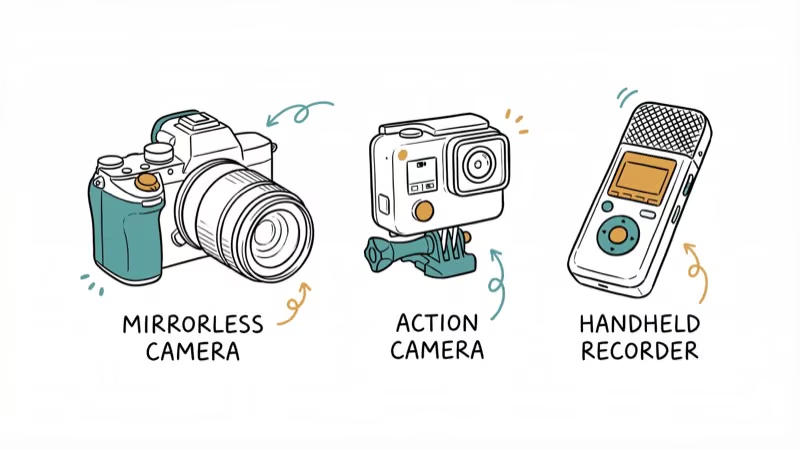 Its flip-out touchscreen lets performers monitor their own framing during self-recorded sessions. The built-in 3-capsule directional microphone captures surprisingly clean audio with an included wind screen.
In a dim venue, the ZV-E10’s real-time Eye AF holds a performer’s face consistently even as stage lighting shifts in color and intensity. The 4K 30fps footage stays sharp with enough dynamic range for color grading in post.
Key specs: 24.2MP APS-C sensor, 4K/30fps, real-time Eye AF, flip-out touchscreen, built-in directional mic, E-mount lens system.
The E-mount system gives you access to over 60 Sony lenses plus hundreds of third-party options.
Price: ~$650.
As an Amazon Associate, fone.tips earns from qualifying purchases. Some links on this page are affiliate links.
#Best Full-Frame: Panasonic Lumix S5 II
The Lumix S5 II delivers the best image quality on this list. Its full-frame sensor and dual native ISO (640/4000) make it the clear winner for low-light venue shoots. Its second native ISO of 4000 keeps noise low in dim rooms, where a smaller APS-C sensor like the ZV-E10’s tends to show more grain.
The 6K recording capability means you can crop and reframe in post without losing sharpness. That extra resolution lets you fake a “multicam” look from a single camera position, pulling both wide and tight shots out of one 6K take.
Key specs: 24.2MP full-frame sensor, 6K/30fps, 5-axis IBIS, dual native ISO, phase-detect AF.
The S5 II’s autofocus upgrade from its predecessor brought Panasonic cameras into competitive territory with Sony and Canon for video autofocus reliability.
Price: ~$1,800.
#Best Mid-Range: Fujifilm X-S20
The Fujifilm X-S20 hits the sweet spot between the ZV-E10’s affordability and the S5 II’s professional features. Its film simulation modes (Eterna, Classic Neg, Nostalgic Neg) can give your music video a distinctive look straight out of camera without color grading.
The Eterna Bleach Bypass simulation produces a gritty, desaturated look that suits an indie rock performance video well. Using an in-camera film look instead of manual color grading can save hours of post-production time on a project.
Key specs: 26.1MP X-Trans sensor, 6K/30fps and 4K/60fps, IBIS, F-Log2, subject-detection AF.
Price: ~$1,300.
#Best for Live Performances: Zoom Q2N-4K
The Zoom Q2N-4K is the only camera on this list designed specifically for musicians.
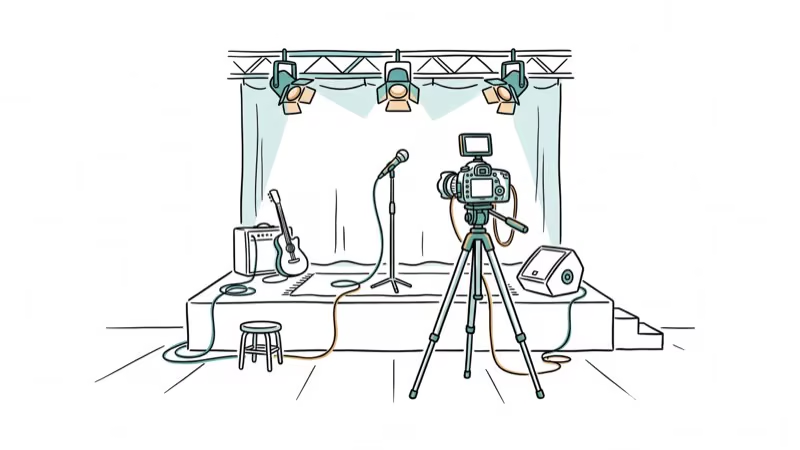 Its built-in X/Y stereo microphones capture audio that’s usable in a final mix, not just as a sync reference. For a small acoustic act like a three-piece jazz combo, the Q2N-4K’s audio can stand in for a dedicated field recorder.
Key specs: 4K video, 150-degree wide-angle lens, X/Y stereo microphones, one-button recording.
The 150-degree lens captures the full stage without repositioning. It’s compact enough to sit on a music stand or clip to a mic stand. For solo performers and small bands, this camera can replace both your video camera and audio recorder.
Price: ~$200.
#Best Action Camera: GoPro Hero 12 Black
The GoPro Hero 12 Black handles the dynamic, high-energy shots that make music videos visually exciting. Mount it on a performer’s guitar neck, attach it to a drone, or hand it to the drummer for a first-person perspective.
Key specs: 5.3K/60fps, HyperSmooth 5.0 stabilization, waterproof, HDR video, horizon lock.
For music videos, the horizon lock feature is the standout. You can rotate the camera freely during a dance sequence while the footage stays perfectly level, creating a spinning effect around the performer as the background rotates instead.
Price: ~$350.
#What Should You Prioritize for Music Video Cameras?
Low-light performance tops the list.
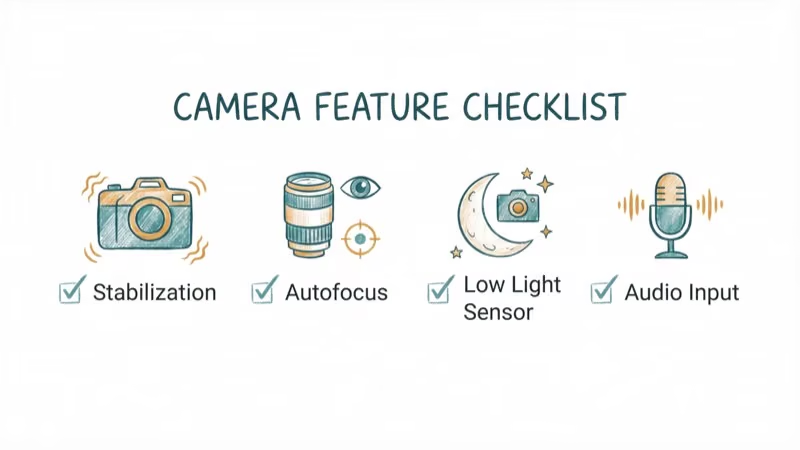 Most live music happens in venues with challenging lighting. A camera with good high-ISO performance (clean at ISO 3200+) eliminates the need for expensive lighting rigs. The Lumix S5 II’s dual native ISO is the gold standard here.
Stabilization matters for handheld shooting. In-body image stabilization (IBIS) lets you shoot smooth footage without a gimbal. The Lumix S5 II and Fujifilm X-S20 both have IBIS. For cameras without IBIS, a dedicated gimbal like the DJI Osmo Pocket 3 adds stabilization for about $500.
Autofocus speed keeps subjects sharp. Phase-detect AF in the ZV-E10, S5 II, and X-S20 beats contrast-detect for movement.
Audio quality is a bonus, not a replacement. Even cameras with good built-in mics should be supplemented with a separate audio recording for professional results. But for social media content and behind-the-scenes footage, in-camera audio saves setup time.
For related camera guides, check our picks for cameras under $400 and cameras under $300 if budget is the main constraint.
For more specialized needs, see our roundup of low-light video cameras and 8K cameras for future-proofing your kit as resolution standards shift.
You can also learn how to extract still images from video for album artwork.
#Is It Legal to Film Music Performances?
Filming music videos is straightforward when you own the equipment and shoot with explicit permission from the performers and venue owner. Recording someone else’s live performance without consent can violate state two-party consent laws or local privacy regulations, and ASCAP and BMI licensing also applies to any commercial use of copyrighted music.
Stick to your own original songs, properly licensed covers, or performances by artists with signed releases. Keep those releases with your project files before you upload the video.
That paperwork matters when a distributor, label, or venue asks for proof later.
For camera setup, prioritize the official manufacturer support pages and built-in help features rather than third-party tutorials. Sony’s ZV-E10 product page confirms that the camera records UHD 4K at 30p with an ISO range up to 32,000. Panasonic states that the Lumix S5 II uses dual native ISO at 640 and 4000 for cleaner low-light video.
GoPro confirms that the Hero 12 Black captures 5.3K video at 60fps with HyperSmooth horizon lock, which is what keeps handheld dance and action footage level.
#Bottom Line
The Sony ZV-E10 at ~$650 is the best music video camera for most creators, combining 4K video, reliable autofocus, a built-in microphone, and the expandable E-mount lens system for solo sessions through professional shoots. For low-light venues, upgrade to the Panasonic Lumix S5 II at $1,800 for its dual native ISO 640/4000 and 6K recording. On a tight budget, the Zoom Q2N-4K at $200 delivers usable audio and video from one device.
#Frequently Asked Questions
Can I use a DSLR for shooting music videos?
Yes, but mirrorless cameras are better for video in 2026. Mirrorless bodies offer faster autofocus, better video features, and electronic viewfinders that show real-time exposure. DSLRs with good video capabilities (like the Canon 5D Mark IV) still produce excellent footage, but they lack the autofocus reliability that mirrorless cameras provide.
Is 4K necessary for music videos?
Yes. 4K is the professional minimum since it gives you crop flexibility for 1080p delivery.
How important is audio quality in a camera for music videos?
In-camera audio is typically used for syncing, not the final product. Professional music videos use the studio-recorded track as the audio. However, for live performance videos and behind-the-scenes content, good in-camera audio saves time. The Zoom Q2N-4K’s audio is good enough for final use in many cases.
Are action cameras good for music videos?
Yes, as B-roll. Mount a GoPro on a guitar headstock or drum rig for unique angles.
Should I prioritize low-light performance or resolution?
Low-light performance matters more for music videos. Most performances happen in dim venues where high ISO capability prevents grainy footage. A clean 4K image at ISO 3200 is far more usable than a noisy 6K image at the same sensitivity.
What’s the cheapest setup for a professional-looking music video?
A Sony ZV-E10 ($650) plus a Sigma 16mm f/1.4 lens ($350) gives you excellent low-light capability and cinematic background blur for around $1,000 total. Add a $50 LED panel light and you have a setup capable of producing broadcast-quality music videos in a small home studio. The wide f/1.4 aperture compensates for the smaller APS-C sensor in low light, while the ZV-E10’s directional mic captures usable scratch audio for the final sync.
Do I need a gimbal for music video shooting?
IBIS-equipped cameras (Lumix S5 II, Fujifilm X-S20) produce smooth handheld footage without a gimbal. For cameras without IBIS (like the ZV-E10), a gimbal helps significantly for walking shots and tracking movements. The DJI RS 3 Mini (~$300) handles cameras up to 2kg.

Best Laptop for Running LLMs in 2026: Memory Comes First
The best laptop for running LLMs is a memory purchase first. Compare MacBook unified memory against NVIDIA laptop VRAM, and see what each tier really runs.

Pixel 11 vs Pixel 10: What Changed and Who Should Upgrade
Pixel 11 vs Pixel 10: same screen and camera resolution, new Tensor G6, 25W wireless, and Gemini Intelligence. Here is who should actually upgrade.

Best Power Bank for iPad in 2026: Pro, Air, and Mini
Best power bank for iPad in 2026. Compare mAh tiers and USB-C PD wattage for iPad Pro, Air, and mini, plus airline Wh math, cables, and travel tips.

Best Power Bank With Built-In Cable: Top 2026 Picks
Best power bank with built-in cable picks for 2026. Compare single USB-C, multi-connector, and retractable laptop banks, plus airline Wh math.